COSMOS warmly welcomes Richa Pokhrel as a new Graduate Assistant. She is a graduate of Tribhuvan University, IOE Thapathali, in Kathmandu, Nepal. At the COSMOS Research Center, Richa helps design, develop, and test social media-based information analysis systems. She also shares what inspired her to join COSMOS and discusses her aspirations and future goals in the field.
Please share a bit about your professional background and experience.
I am a master’s student in Computer Science with backend development experience and a strong foundation in software engineering. I have worked with Python, Java, RESTful APIs, and SQL databases, gaining skills in system design, data processing, and debugging scalable applications. As a Graduate Assistant at COSMOS, I continue to enhance my technical and analytical skills while contributing to research projects.
What attracted you to join the COSMOS Research Center? What aspects of COSMOS stood out to you and why?
I was particularly drawn to Prof. Agarwal’s research because of his impactful work in computational social science and his vision of using data-driven methods to better understand online information ecosystems. His leadership at the COSMOS Center in bringing together interdisciplinary research to study issues like information diffusion and adversarial information campaigns is very inspiring. The innovative research culture he has fostered makes COSMOS an exciting place to learn and contribute.
How do you anticipate your role at COSMOS helping your growth on both a personal and professional level? Are there any specific skills or experiences you’re looking to gain?
Working at COSMOS will help me grow professionally by allowing me to contribute as a full-stack developer for BlogTracker while supporting research on collective action. This role will strengthen my skills in building research tools, handling large-scale data, and collaborating with interdisciplinary researchers. Personally, I hope to gain deeper insight into how technology can support social science research and develop stronger problem-solving and teamwork skills.
From your experience, what tips, insights, or advice would you share with someone starting a new role at COSMOS?
My advice would be to stay curious and open to learning from different disciplines. COSMOS brings together technology and social science, so being willing to explore new ideas and ask questions is very valuable. It is also helpful to communicate and collaborate closely with the research team, since understanding the research goals makes it easier to build tools like the Blog Tracker effectively. Finally, take initiative and treat challenges as opportunities to learn and grow.
If you could share a meal with any historical figure or fictional character, who would it be, and what would you want to talk about and want to learn from them?
If I could share a meal with someone, I would choose Alan Turing. I would love to talk with him about how he approached complex problems and how he imagined the future of computing and artificial intelligence. I would also want to learn about his thought process when developing ideas that were far ahead of his time, and how curiosity and persistence guided his work.
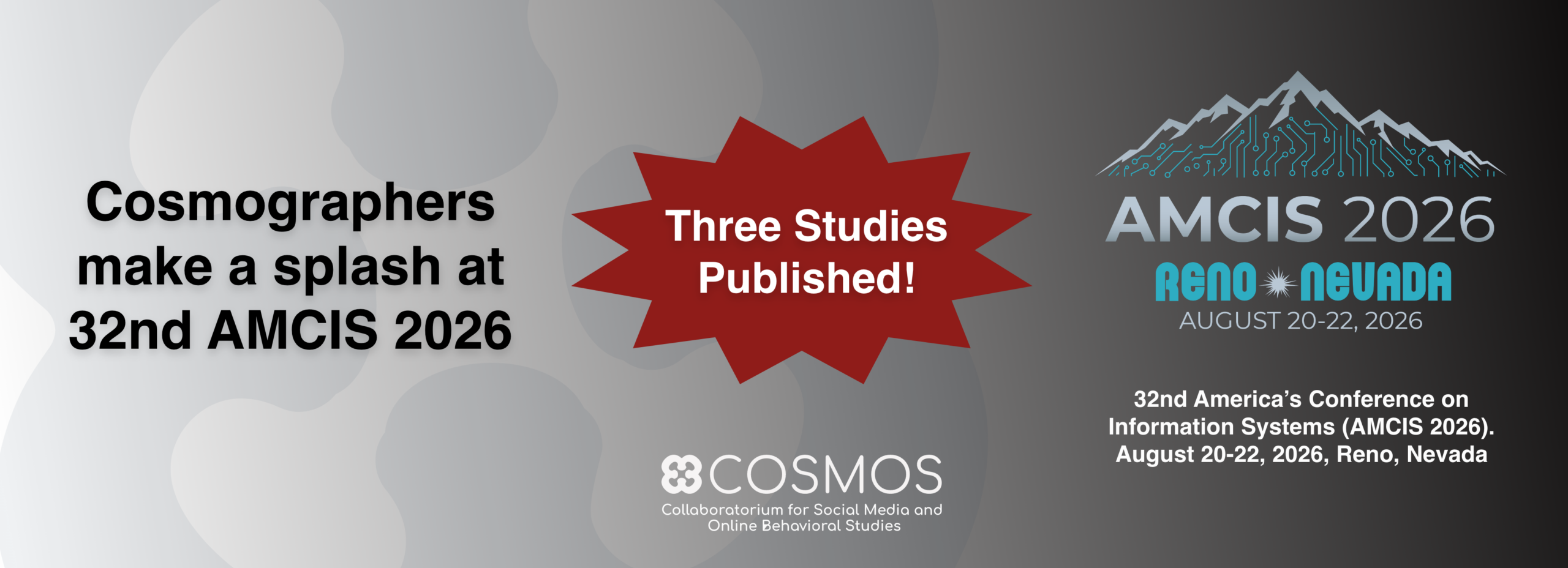
COSMOS at UA Little Rock continues to push the boundaries of socio-computational research, unveiling two groundbreaking studies at the prestigious and highly interdisciplinary 18th International Conference on Social Computing, Behavioral-Cultural Modeling, & Prediction (SBP-BRiMS). Hosted at Carnegie Mellon University, this elite forum brings together global leaders in computer science and social behavioral modeling to address the world’s most pressing digital threats.
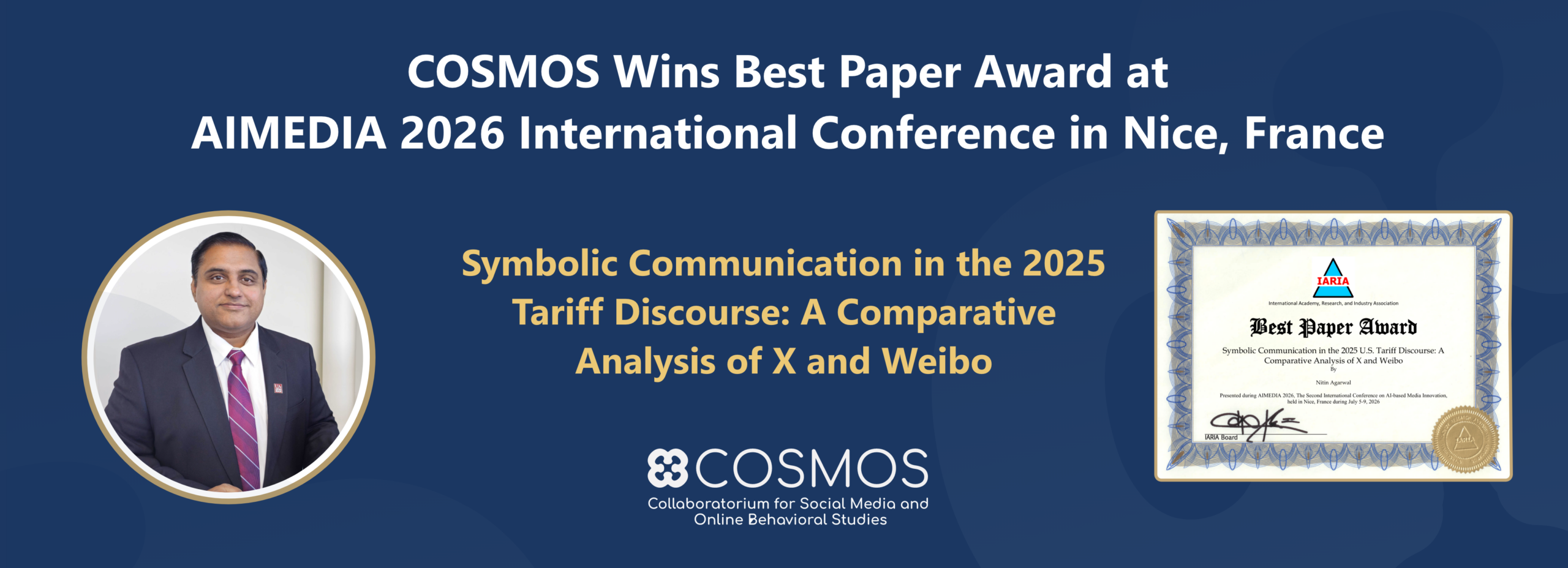
The first study, entitled “Analyzing Democratic Trust Through Symbolic Communication: A Case Study of Taiwan’s Presidential Election,” investigates how symbolic content in TikTok videos influences trust formation during 2024 Taiwan presidential election, using a novel dual-frame method to compare first and key video frames. The analysis shows that first frames are more effective for conveying symbolic content, especially social symbols, while standout frames better capture non-symbolic information, and that cultural and social symbols significantly outperform political symbols in building trust. Overall, the findings suggest that strategically incorporating diverse symbolic elements can enhance democratic communication and strengthen public trust in electoral processes. This study received the best paper award at the conference.
The second study, entitled “Examining Generational Influence in Online Toxicity: Context-Dependent Patterns in Health and Political Discourse,” examines how conversational context, specifically parent, grandparent, and great-grandparent comments, affects the prediction of toxicity across platforms, analyzing large-scale discussions from COVID-19 Reddit health discourse and Russia–Ukraine Telegram political discourse. Using ensemble machine learning, the authors achieved strong predictive performance (F1 scores of 68–77%) and found both universal and context-dependent patterns, with immediate parent influence consistently predicting extreme toxicity while deeper conversational layers (e.g., grandparents) better captured moderate toxicity in political contexts. Overall, the results demonstrate that incorporating generational conversational context significantly improves cross-platform toxicity prediction and reveals discourse-specific behavioral dynamics.
Both studies leverage AI-driven social computing approaches to analyze large-scale social media data, but they differ in focus and methodological emphasis. The TikTok study applies advanced large language models to interpret symbolic visual content and its role in trust formation, highlighting how multimodal AI can decode cultural and social signals in short-form video. In contrast, the cross-platform toxicity study employs ensemble machine learning and conversational thread reconstruction to model how hierarchical context shapes toxic behavior, emphasizing structural and temporal dynamics in online discourse.
Together, these studies demonstrate the power of AI in uncovering nuanced patterns in digital communication, whether through symbolic meaning-making or conversational context modeling. Scientifically, they advance methods for integrating multimodal and contextual data into social computing frameworks; societally, they offer actionable insights for strengthening democratic discourse, improving content moderation, and designing interventions to foster trust while mitigating harmful online behavior.
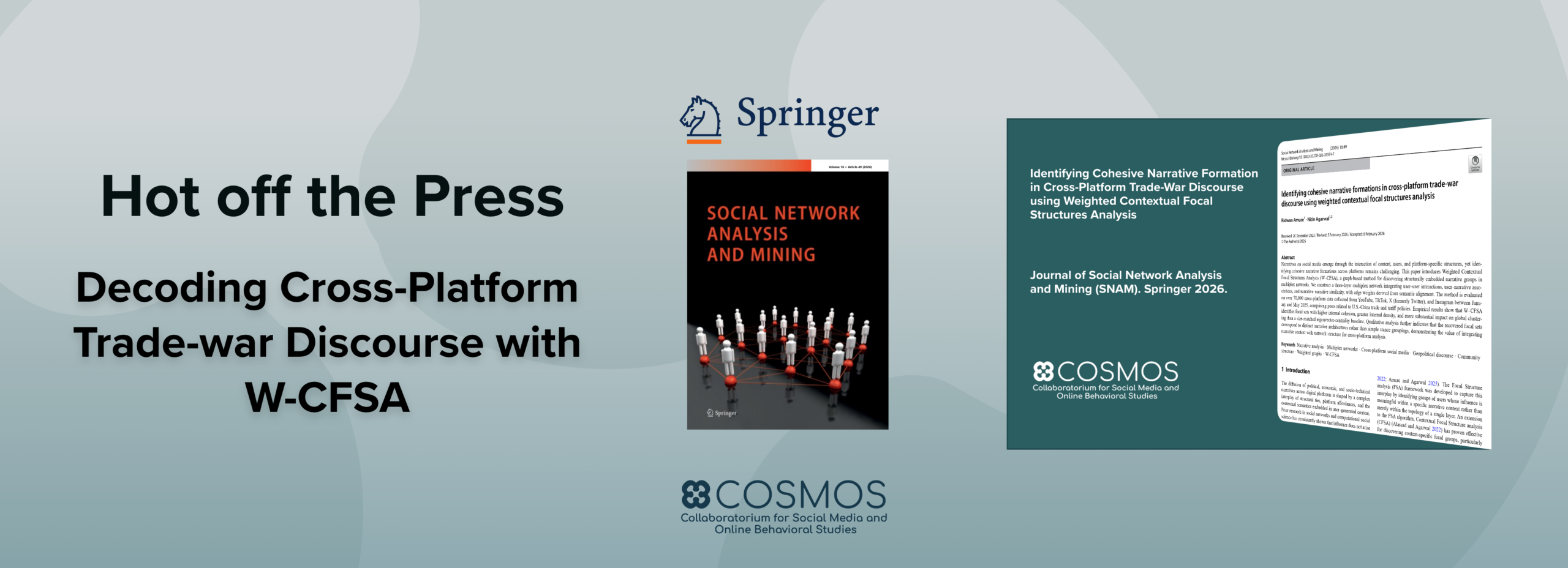
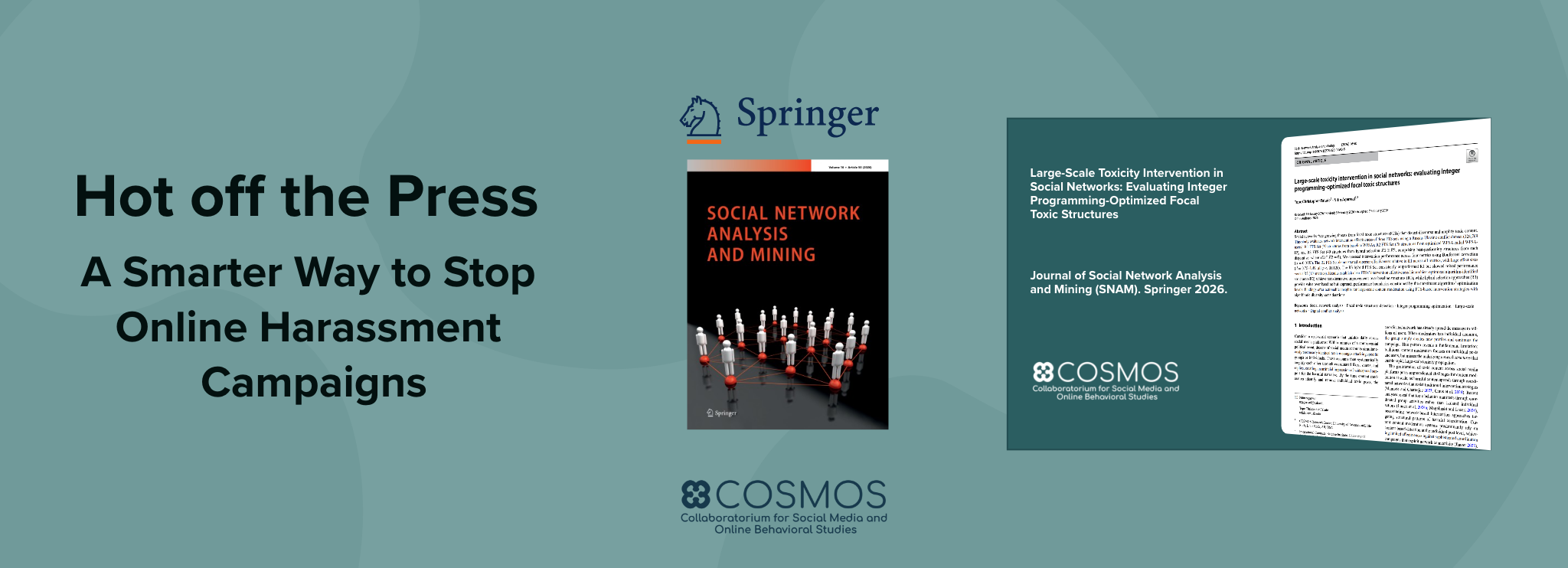
COSMOS continues to advance global scholarship in AI and social network analytics with a new study published in the Journal of Social Network Analysis and Mining, a leading Springer Nature journal recognized for rigorous research at the intersection of network science, data analysis, and societal impact.
In this article, COSMOS researchers introduce SEPS (Semi-Supervised Embedding-based Propagation Scoring), a novel framework for detecting anomalous YouTube channels. By leveraging co-commenter networks, networks of users who comment together across multiple videos, the method combines structural and engagement features to uncover channels exhibiting suspicious behavior, including manipulation of engagement metrics, toxic content dissemination, and potential adversarial information campaigns.
Using a large-scale dataset from the Indo-Pacific region, spanning 97 channels, 702,160 videos, 12.5 million commenters, and 123.9 million comments, SEPS identifies previously unknown anomalous channels while requiring only a small number of labeled examples to guide the learning process. The model employs graph neural networks to generate embeddings for each channel and propagates partial labels through a classification head, effectively separating anomalous from normal channels.
Key findings reveal that SEPS outperforms previous detection methods across recall, precision, and F1-score metrics. Even when only a handful of known anomalous channels are provided, the model maintains high cluster purity, keeping unlabeled anomalous channels grouped together while minimizing false positives. Synthetic dataset experiments further validate the approach, showing its robustness and adaptability to larger, dynamic networks.
The research highlights how anomalous behavior on YouTube is not solely tied to individual content or user activity but emerges from collective interaction patterns. By examining co-commenter networks, SEPS captures subtle signals of coordinated or suspicious activity that may otherwise go unnoticed, offering a powerful tool for platform governance and content integrity.
This work underscores COSMOS’s leadership in AI-powered social media analytics, combining graph-based machine learning, computational social science, and ethical AI to tackle pressing challenges in digital platforms. By publishing in the Journal of Social Network Analysis and Mining, COSMOS continues to shape international discourse on algorithmic transparency, anomaly detection, and the resilience of online ecosystems. Read the full article here.
Prof. Nitin Agarwal has been selected in the prestigious Distinguished Visitor Program (DVP) by the IEEE Computer Society. This recognition places him among a select group of global technology leaders invited to share their expertise with professional and student chapters worldwide through the Distinguished Visitor Program.
This highly competitive selection highlights Prof. Agarwal’s exceptional contributions to research, education, professional service, and the broader technical community. Through COSMOS, he leads interdisciplinary research teams studying social media dynamics, online behavior, and digital influence, with a focus on understanding the complex interactions between technology, society, and human behavior in the digital age.
Prof. Agarwal has built an internationally recognized research program at the intersection of artificial intelligence, social computing, and cognitive threat analysis. His work has had a sustained impact across academia, industry, and government, supported by major federal agencies and influencing policy, operational practices, and global research agendas.
He has also demonstrated outstanding leadership within IEEE and the IEEE Computer Society. As an active and committed contributor to conferences, publications, technical committees, and community-building efforts, he reflects a deep commitment to advancing IEEE’s mission of fostering technological innovation and excellence for the benefit of humanity.
An exceptional communicator and educator, Prof. Agarwal has a rare ability to translate complex technical concepts into accessible and compelling narratives for diverse audiences, from students and early-career researchers to senior technical leaders and policymakers. This makes him particularly well-suited for the Distinguished Visitor role, where intellectual depth, clarity of communication, and professional stature are essential.
Beyond his technical achievements, he brings professionalism, integrity, and a collaborative spirit to every engagement. He represents IEEE with distinction and serves as a role model for faculty, students, and professionals alike. Prof. Agarwal’s selection underscores his global research impact and his commitment to advancing knowledge at the forefront of AI, cybersecurity, and social computing, inspiring the next generation of technology innovators worldwide.
Reflecting on the honor, Prof. Agarwal said, “It is an honor to be selected in the IEEE Distinguished Visitor Program. I look forward to participating and enriching the program and the global IEEE community.”
Sanket Bhangale is a curious and forward-thinking technologist driven by a deep interest in intelligent systems and how complex ideas translate into real-world impact. He approaches problems with a builder’s mindset, thoughtful, analytical, and always focused on creating things that are scalable and meaningful. With a strong inclination toward innovation and long-term vision, he is particularly drawn to the evolving space of autonomous and AI-driven technologies. Beyond his professional pursuits, he values continuous learning, exploring new ideas, and maintaining a balanced lifestyle that fuels both creativity and discipline.
Please share a bit about your professional background and experience.
I graduated from Istanbul Technical University, where I studied AI and Data Engineering for my bachelor’s degree. During my bachelor’s studies, I completed an internship as a Machine Learning Engineer in Berlin, Germany, and worked as a Data Scientist at Turkish Airlines Technology during my senior year. Right now, I am pursuing my PhD in Computer Science.
What role do you play at COSMOS?
I am a graduate research assistant at the COSMOS Research Center and am helping Prof. Agarwal, who is leading the projects on collective action and toxicity.
What attracted you to join the COSMOS Research Center? What aspects of COSMOS stood out to you and why?
As an individual who wanted to pursue further research after completing my bachelor’s degree and who loves storytelling, I felt that social computing was a good match for me. Prof Agarwal is a world-renowned expert in Social Computing; therefore, it was natural for me to join the COSMOS Research Center that he is leading and learn how to conduct research from him. At COSMOS, we examine how social media drives human behavior from several perspectives. The significant computational and interdisciplinary research infrastructure that Prof. Agarwal has established through his numerous highly prestigious grants enables our research to run much more smoothly.
How do you anticipate your role at COSMOS helping your growth on both a personal and professional level? Are there any specific skills or experiences you’re looking to gain?
As a graduate research assistant under Prof. Agarwal’s tutelage, I am looking forward to learning every aspect of conducting research, including literature surveys, helping conduct experiments, and helping write papers. My goals are to grow as a researcher, improve my soft and hard skills, such as learn foundational theories in computational social science, apply them to novel research ideas, and improve my communication of these findings.
From your experience, what tips, insights, or advice would you share with someone starting a new role at COSMOS?
Prof Agarwal has fostered a professional, collaborative, real-world problem-solving environment and assembled a great team and resources at the COSMOS Research Center. He has an infectious energy and a hard-working work ethic. He is highly regarded in the global research community. We all should learn from him and contribute to the scientific community. We have a great team at COSMOS, so engage and learn from others – and enjoy while doing so!
If you could share a meal with any historical figure or fictional character, who would it be, and what would you want to talk about and want to learn from them?
I would say John McCarthy, also known as the “father of AI”. The reason is that I really enjoyed my bachelor’s education and believe that the foundational ideas that underpin today’s development are crucial to understand. I would like to discuss what McCarthy would think if he saw the current state of AI, especially after late 2022, when Large Language Models began attracting massive audiences.
During the final semesters of my doctoral studies at UALR, I became familiar with Prof. Agarwal’s research and was impressed by the significant interdisciplinary work he was leading. I joined him and started working at COSMOS as a graduate research assistant on his projects. I was strongly interested in the opportunity to apply mathematical methods to important, real-world problems. When I began searching for a postdoctoral research fellowship position, I reached out to him to express my interest. We had several discussions about how my background in mathematics could support and collaborate with his future research projects. I appreciated his vision and the opportunity to contribute to valuable research projects as a postdoctoral fellow.
What role did COSMOS play in your educational career at UALR?
Prof. Agarwal and COSMOS played a key role in my scholarly development. I initially joined the team as a graduate research assistant while completing my Ph.D., and after earning my doctorate, I continued as a postdoctoral fellow. This experience expanded my perspective on how mathematics can be applied beyond theory. It strengthened my research expertise, exposed me to interdisciplinary collaboration, and provided hands-on experience working with real-world data. Under Prof. Agarwal’s mentorship at COSMOS, I worked on several research projects, including narrative analysis, churn analysis, and epidemiology models using data from social media platforms. These projects enabled me to apply mathematical modeling and computational methods to important, real-world problems. Prof. Agarwal’s research projects at COSMOS helped bridge the gap between theoretical mathematics and applied computational research, developing my skills as an interdisciplinary researcher.
How would you describe the research that you worked on while at COSMOS? In other words, what was the specific area in which you researched?
At COSMOS, Prof. Agarwal introduced me to two research projects on narrative analysis and churn analysis. The first project focused on narrative analysis, examining how narratives spread and evolve on social media platforms. We examined whether narratives behave like contagious processes and developed mathematical and computational models to track narrative diffusion over time. The goal was to better understand how ideas, information, and opinions propagate through online communities. In the second project on churn analysis in social networks, we developed predictive tools to understand why users disengage or leave online platforms. By analyzing user behavior patterns, we aimed to identify factors that influence participation, retention, and long-term engagement. Together, these two projects combined statistics, data science, and mathematical modeling to better understand socio-technical behaviors in digital environments.
How did COSMOS shape your career path or personal growth?
Prof. Agarwal had a strong impact on both my professional direction and personal progress. His mentorship strengthened my ability to manage multiple research projects, collaborate across disciplines, and supervise students engaged in research. Most importantly, he helped me reimagine my view of mathematics. He showed me how to connect theory with real-world applications, making mathematics more dynamic, relevant, and powerful in my scholarly work. This experience influenced how I design courses, mentor students, and structure research projects in my current role.
Since leaving COSMOS, what roles/positions/jobs have you had? What is your current work?
After leaving COSMOS, I joined Georgia Southern University as an Assistant Professor in the Department of Mathematical Sciences. I teach undergraduate and graduate courses. In many of my upper-level classes, I incorporate project-based learning. I encourage students to start early, set clear milestones, and collaborate to complete meaningful research-driven projects. I have also taught a Research Methods course and developed a new course, Advanced Data Science, where I integrate the modeling techniques and interdisciplinary perspective I learned while working with Prof. Agarwal at COSMOS. Additionally, Prof. Agarwal’s mentorship during my postdoctoral fellowship at COSMOS strengthened my ability to supervise students and coordinate research efforts. This has played an essential role in developing my research program at Georgia Southern University, where I continue to work at the intersection of mathematics, data science, and real-world applications.
Please share some memories from your time at COSMOS.
One of the most defining experiences of my time at COSMOS was working as a Postdoctoral Research Fellow under the mentorship of Prof. Agarwal. His leadership and guidance played a key role in my professional development. He consistently challenged me to evaluate critically, supported my growth as an independent researcher, and reinforced my ability to undertake complex, impactful research projects. While at COSMOS, I was exposed to opportunities that broadened my career perspective, including pathways in both academia and industry. Through collaborative data analysis and interdisciplinary research projects, I gained an enhanced appreciation for applying mathematical and computational methods to important, real-world problems. The weekly Friday research meetings were notably influential. They provided a structured environment for intensive discussion, idea development, and careful refinement of our research both before and after publication. These sessions strengthened my analytical thinking, academic communication, and collaborative skills. Overall, my experience at COSMOS strongly influenced my scholarly identity and enhanced my appreciation for interdisciplinary collaboration, academic interest, and sustained research engagement.
What advice would you have for current Cosmographers?
When I first joined COSMOS, it was challenging as it was a new environment, new research problems, new discipline, etc. However, with Prof. Agarwal’s consistent support and understanding, things improved and became successful. His advice to me was that every difficult beginning can become a great opportunity if you do not give up. My advice to students at COSMOS is simple: listen to Prof Agarwal and keep going. Prof. Agarwal has created an amazing environment at COSMOS – one that has world-class technical infrastructure, highly supportive teams, real-world research opportunities, and a terrific support system. Do not waste your time. Use each opportunity to learn and work on different projects. Try to join as many projects as you can. Each project builds your experience and shapes your skillset. Grab these opportunities. Rewards and achievements will come sooner than you think. Do not be afraid to take on new tasks or learn new skills. Step outside your comfort zone. Growth happens when you challenge yourself. Stay focused on your goals. Even if you do not see results right away, trust that your hard work will pay off. Stay consistent. Stay motivated. Believe in yourself. Publish your work, contribute to the scientific community, and aim high. Most importantly, never give up. The effort you make today will become the success you celebrate tomorrow.
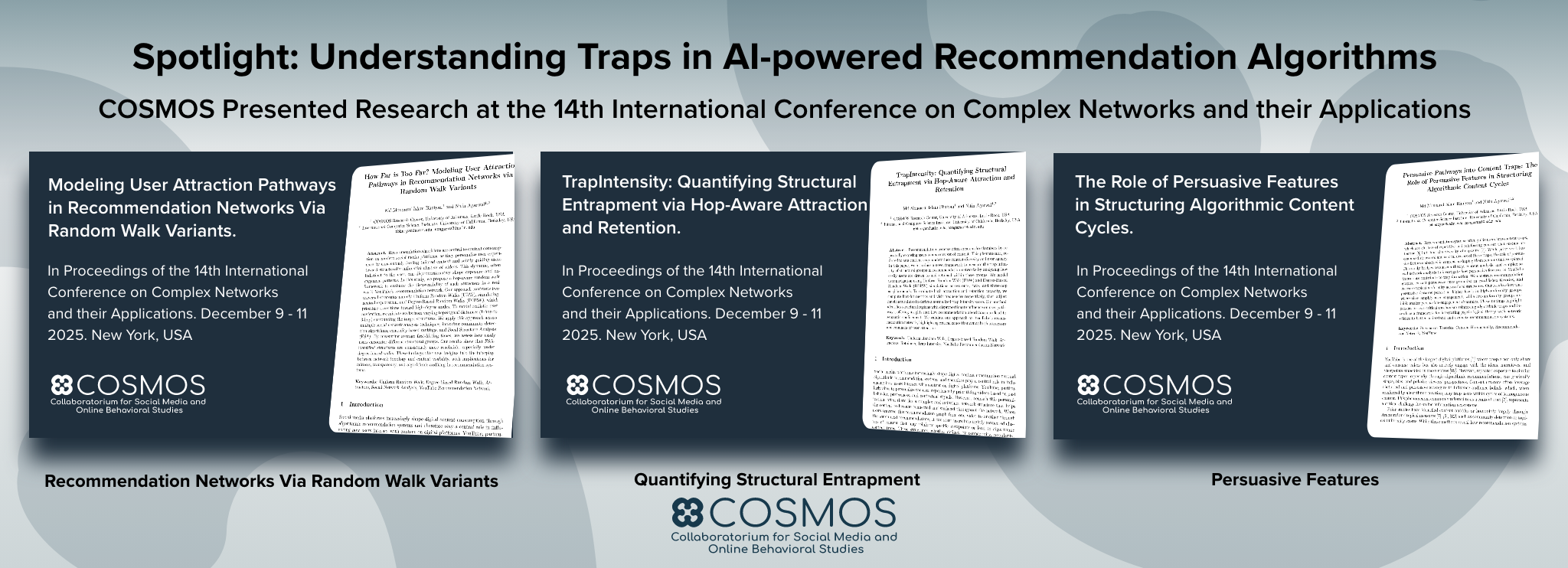
COSMOS at UA Little Rock continues to push the boundaries of socio-computational research, unveiling three groundbreaking studies at the prestigious and highly interdisciplinary 18th International Conference on Social Computing, Behavioral-Cultural Modeling, & Prediction (SBP-BRiMS). Hosted at Carnegie Mellon University, this elite forum brings together global leaders in computer science and social behavioral modeling to address the world’s most pressing digital threats.
The study, entitled “Studying Emotional and Trust-building Effects of Symbolic Communication on YouTube,” analyzes Taiwan’s information campaigns. LLMs were used in the research to reveal that cultural symbols drive significantly higher emotional engagement and trust than non-symbolic content, proving that visual semiotics are critical to digital political discourse.
Another study, entitled “Structure, Semantics, and Attraction: Analyzing Homophily in Recommender Networks,” used Focal Structure Analysis (FSA) to identify dense network subgraphs on YouTube that act as behavioral “traps.” These structures exhibit high topical uniformity, effectively narrowing user exposure and reinforcing ideological silos.
The third study, entitled “Uncovering Structural Consistency in YouTube Channels,” proposed a new unsupervised framework that characterizes YouTube channels by the semantic alignment of their metadata (titles, descriptions) with actual transcripts. The study identified three distinct behavioral profiles, offering a scalable method to detect narrative misrepresentation without manual labeling.
While unique in their focus, from visual semiotics to network topology and metadata alignment, these studies collectively advance AI and Social Computing. While each paper addresses a unique facet of AI, i.e., from multi-modal signal processing to geopolitical modeling, they collectively advance our ability to secure the socio-cognitive domain. COSMOS’s contributions at SBP-BRiMS highlight a unified mission: bridging the gap between social science theory and advanced machine learning to build community resilience.
By integrating Large Language Models (LLMs) with traditional network analysis, COSMOS is building the tools necessary to understand and mitigate harmful behaviors, ensuring transparency and resilience in our increasingly complex social-cyber world. By pioneering these socio-computational approaches, COSMOS is not only advancing the state-of-the-art in AI and YouTube forensics but is also providing policymakers and technologists with the tools needed to mitigate harmful behaviors and neutralize coordinated cognitive threats in our increasingly complex digital world.
COSMOS continues to advance global scholarship in AI and network science with a new study published in the Journal of Applied Network Science, a premier, highly selective Springer Nature journal recognized for influential research at the intersection of networks, data science, and societal impact.
In this article, COSMOS researchers investigate how symbolic content, such as social, cultural, and political imagery, shapes information diffusion within YouTube’s recommendation ecosystem. Using large-scale social network analysis and advanced AI-enabled methodologies, the study compares the propagation dynamics of symbolic versus non-symbolic videos across multiple recommendation depths.
Key findings reveal that symbolic content is structurally advantaged within recommendation networks. Videos containing symbolic cues exhibit significantly higher influence and visibility, as measured by eigenvector centrality, closeness centrality, and PageRank, indicating that such content travels faster and occupies more central positions in the network. In contrast, degree and betweenness centrality show fewer differences, suggesting that algorithmic bias emerges not merely from volume of connections but from how influence is amplified algorithmically.
The research further demonstrates that symbolic content fosters tighter communities and deeper clustering, reinforcing echo chambers and raising concerns about algorithmic amplification in adversarial information campaigns. These findings have critical implications for AI-driven platform governance and the responsible design of recommender systems.This work underscores COSMOS’ leadership in AI-powered social media analytics, combining network science, computational social science, and ethical AI to address pressing global challenges. By publishing in the Journal of Applied Network Science, COSMOS continues to shape international discourse on algorithmic transparency, bias, and resilience in online platforms. Read the full article here.
COSMOS Director Prof. Nitin Agarwal represented the University of Arkansas at Little Rock at the 17th IEEE/ACM International Conference on Advances in Social Networks Analysis and Mining (ASONAM), held in Niagara Falls, Ontario, Canada, contributing to a high-profile international panel on the growing influence of large language models (LLMs) on social networking and social media.
The panel, moderated by Rokia Missaoui (Université du Québec en Outaouais, Canada), brought together leading experts from North America, Europe, and Asia, including Jean-Loup Guillaume (La Rochelle Université, France), Hongxin Hu (University at Buffalo, USA), Rasha Kashef (Toronto Metropolitan University, Canada), Kwan Hui Lim (Singapore University of Technology and Design), and Tamer Özsu (University of Waterloo, Canada).
Prof. Agarwal’s remarks focused on the transformative role of LLMs in shaping social media ecosystems, with particular attention to their impact across academia and industry. He highlighted both the positive potential—such as accelerating research, enhancing teaching and learning, and enabling advanced analytics in sectors like banking and e-commerce—and the risks, including manipulation, deception, bias, opacity, and adversarial misuse at scale.
Drawing on COSMOS’s long-standing research leadership in AI, social computing, and cognitive security, Prof. Agarwal emphasized critical challenges and design considerations for responsibly integrating LLMs into social network analysis and mining, including transparency, explainability, and human-AI collaboration. He also discussed emerging opportunities for using LLMs to query complex social media data and generate interpretable explanations, a key step toward trustworthy and actionable social media intelligence.
Participation in this panel underscores COSMOS’s growing global footprint and its role in advancing responsible, interdisciplinary AI research on the world stage.