Prof. Nitin Agarwal Receives $5 Million Grant to Strengthen Community Resiliency Against Cognitive Attacks

LITTLE ROCK, Ark. — Dr. Nitin Agarwal, Maulden-Entergy Chair and Donaghey Distinguished Professor of Information Science at the University of Arkansas at Little Rock, has received a $5 million research award from the U.S. Department of War to advance socio-computational methods for mitigating cognitive attacks and strengthening community resiliency in digital environments.

Through the project, titled “Developing Socio-computational Methods to Strengthen Community Resiliency to Mitigate Cognitive Attacks,” Prof. Agarwal, founding director of the Collaboratorium for Social Media and Online Behavioral Studies (COSMOS) Research Center at UA Little Rock, and his team will advance their groundbreaking work in understanding and mitigating cognitive threats in the digital age.

The award was championed through support from U.S. Sen. John Boozman, who continues to be a strong advocate for the innovative, cutting-edge research taking place at UA Little Rock and COSMOS.

“I am pleased to support UA Little Rock and its Collaboratorium for Social Media and Online Behavioral Studies. This award recognizes the significance of this program to our national security,” Boozman said. “The important research conducted here will enhance our ability to counter the use of novel social media tactics by foreign extremists and terrorist groups threatening the United States and our allies.”

“We are extremely grateful for the support from UA Little Rock leadership and U.S. Sen. John Boozman for championing this vital research,” Prof. Agarwal said. “This funding helps COSMOS Research Center continue to develop analytical tools and capabilities to strengthen our national defense and security apparatus against cognitive threats.”

The research addresses the growing threat posed by coordinated adversarial influence operations, online extremism, and other forms of cognitive warfare conducted through social media and digital platforms. As online narratives increasingly shape perceptions, behaviors, and societal cohesion, the project seeks to develop science-driven approaches to understand, predict, and mitigate harmful information campaigns before they escalate into real-world consequences.

“Social media has evolved into a contested cognitive battlespace where narratives can be weaponized to manipulate beliefs, sow discord, and influence collective behavior at unprecedented speed,” said Prof. Agarwal. “This project aims to strengthen community resiliency by developing computational methods that help identify harmful narrative dynamics early, understand how they spread across networks, and inform effective intervention strategies.”

The project will advance socio-computational science through six major research thrusts: modeling narratives and networks, modeling toxicity in online communities, understanding mob dynamics, churn analysis, contextual network characterization, and large-scale data collection and dashboarding.

Researchers will develop multimodal approaches to extract and analyze narratives across digital ecosystems, including how narratives evolve through merging, splitting, and mixing over time. The project will also examine the co-influence between narratives and social networks to better understand how online communities amplify coordinated campaigns.

A key component of the effort involves adapting epidemiological modeling techniques to study the spread of toxicity online, similar to modeling varying levels of infection in public health systems. These models will support science-driven decision-making related to intervention strategies and community health in digital spaces.

The research will further investigate the formation and diffusion of online mobs and coordinated collective behavior, enabling simulations that identify favorable and unfavorable conditions for mobilization. Additional efforts will focus on churn analysis to understand participant dynamics in influence campaigns and determine whether campaigns are approaching critical mass.

The project also includes the development of interoperable data collection and analytics frameworks that integrate multiple streams of information into standardized formats for rapid dashboarding and operational analysis. These tools are intended to support policymakers and decision-makers with near-real-time situational awareness and predictive analytics capabilities.

In addition to advancing research, the initiative will support workforce development and training activities in big data analytics, machine learning, artificial intelligence, and security applications, helping strengthen the future AI and security workforce in Arkansas and beyond.

The award continues the longstanding partnership between Prof. Agarwal’s COSMOS Research Center and the U.S. Department of War in advancing research at the intersection of artificial intelligence (AI), social computing, and national security, specifically in the cognitive domain.

The COSMOS Research Center at the University of Arkansas at Little Rock conducts interdisciplinary research focused on social computing, AI-enabled socio-cognitive threat mitigation, narrative analytics, online behavioral modeling, and cognitive security.
Prof. Nitin Agarwal Receives $5 Million Award to Mitigate Coordinated Cognitive Threats

Dr. Nitin Agarwal, Maulden-Entergy Chair and Donaghey Distinguished Professor of Information Science at the University of Arkansas at Little Rock, has received a $5 million award to research and develop strategies to evaluate and defend against coordinated cognitive threats.

The award will fund research and development of artificial intelligence (AI)-informed socio-computational models to enhance situational awareness by detecting, examining, evaluating, measuring, and predicting the cognitive threat level or impact of adversarial information campaigns. Unchecked online information environments can evolve rapidly, enabling adversaries to exploit them to disrupt military operations through protests and other “non-lethal” resistance.

Agarwal, founding director of the Collaboratorium for Social Media and Online Behavioral Studies (COSMOS) Research Center at UA Little Rock, and his team will advance their groundbreaking work in understanding and mitigating cognitive threats in the digital age.

Agarwal said, “We need to develop scientific approaches to mitigate emerging cognitive threats in a global context, equip our warfighters with these capabilities, and strengthen community resiliency.”

AI-enhanced cognitive threats have already become a key element in conflicts between the U.S. and China. Agarwal highlighted, for instance, that misleading narratives in the Indo-Pacific region frequently paint a negative picture of the U.S.  Adversaries aim to manipulate local opinions against U.S. forces by spreading falsehoods.

“Such influence operation tactics can be employed clandestinely in a low-cost, low-risk context. Military leaders can expect to encounter an increased volume of adversary-generated AI-amplified social media-driven information campaigns,” Agarwal mentioned.  “Socio-cognitive threats are increasingly becoming – 1) a collective phenomenon and 2) multimedia-centric. This project aims to advance the state of socio-computational science and AI to mitigate AI-enhanced cognitive threats and strengthen community resiliency. The developed approaches will be validated and demonstrated in real-world use cases.”

The award was championed through support from U.S. Sen. John Boozman, who continues to be a strong advocate for the innovative, cutting-edge research taking place at UA Little Rock and COSMOS.

“I am pleased to support UA Little Rock and its Collaboratorium for Social Media and Online Behavioral Studies. This award recognizes the significance of this program to our national security,” Boozman said. “The important research conducted here will enhance our ability to counter the use of novel social media tactics by foreign extremists and terrorist groups threatening the United States and our allies.”

“We are extremely grateful for the support from UA Little Rock leadership and U.S. Sen. John Boozman for championing this vital research,” Agarwal said. “This funding helps COSMOS Research Center continue to develop analytical tools and capabilities to strengthen our national defense and security apparatus against cognitive threats.”

These models and their research will then be transitioned and incorporated into COSMOS’ software, such as BlogTracker and V(ideo)Tracker to help bring the developed models and techniques closer to the operational community.

This award also includes funding for training exercises for the U.S. on the changing domain in security of big data analytics, data management, machine learning, and AI with applications.

“The project helps create exciting opportunities for our students and research staff through exposure to real-world problems and stimulates them to develop science-based solutions,” Agarwal said. “This funding will also enhance COSMOS’ AI and high-performance computing infrastructure to scale up multimedia data analysis and sensemaking.”

The award is expected to fund around 15 graduate assistantships, several postdoctoral research fellowships, data engineers, and network administrators.

Students who work on the project will learn valuable skills in data, artificial intelligence, natural language processing, and machine learning.

“Through these projects, we are training our students to be future-ready innovators to tackle real-world challenges,” Agarwal said. “These skills are highly transferable across any technology-driven environment. Even before graduation, COSMOS students receive job offers from top tech companies such as Amazon, Google, Microsoft, Apple, and many other Forbes 100 companies. For those pursuing academic careers, many secure tenure-track faculty positions at leading universities. Our groundbreaking research is not only advancing the disciplines of social computing and AI but also establishing COSMOS and UA Little Rock as leaders in innovation.”

Dr. Nitin Agarwal Receives $5 Million Grant to Combat Socio-Cognitive Threats

Dr. Nitin Agarwal, founding director of the Collaboration for Social Media and Online Behavioral Studies (COSMOS) Research Center at the University of Arkansas at Little Rock, has received $5 million from the Army Research Office to evaluate and defend against emerging cognitive threats.

The Army Research Office is a directorate of the U.S. Army Combat Capabilities Development Command Army Research Laboratory.

The two year project aims to identify research gaps in deviant socio-technical behaviors, shape an agenda focused on developing strategies that can counter emerging threats, and create tools for near real-time analysis of such threats.

“Narratives on social media could be easily weaponized and propagated at frighteningly fast speeds,” Agarwal said. “Such insidious threats that attempt to influence beliefs and behaviors need to be considered as modern weapons of cognitive hijacking. We need to develop scientific approaches to combat these emerging threats in a global context, equip our warfighters with these capabilities, and strengthen community resiliency.”

Agarwal, Jerry L. Maulden-Entergy Endowed Chair and Distinguished Professor in the Department of Information Science, says these threats are increasingly flash mob-type events, where groups self-organize and coordinate in cyberspace, then disperse. Coordinated cognitive attacks can cause stock market frenzy, violent protests, highly coordinated cyberattacks on public infrastructure, for instance. To an outsider such acts may look arbitrary, however intense coordination happens in the background.
“Given the evolving technological landscape and increasing complexity of cognitive attacks, research is warranted to develop multidisciplinary and theoretically grounded capabilities to evaluate emerging socio-cognitive threats that can serve the needs of our military at strategic, tactical, and operational levels,” Agarwal said.

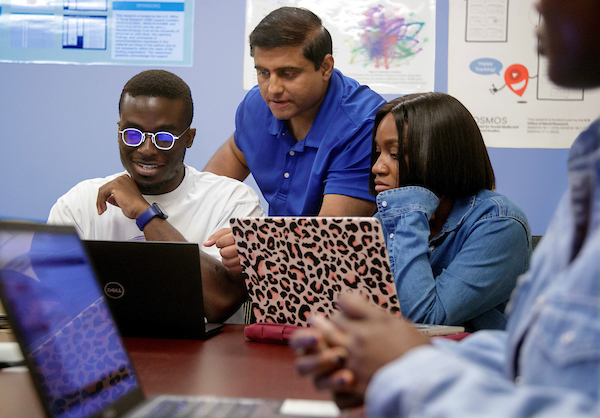
Dr. Nitin Agarwal works with students in the COSMOS Research Center researching social media and online behavior. Photo by Benjamin Krain.

U.S. Sen. John Boozman is a strong advocate for basic and applied research at UA Little Rock.

“The evolving nature of social media and the changing tactics our adversaries use to spread misinformation requires us to develop a strategy to respond,” Sen. Boozman said. “Dr. Agarwal’s research will help create critical tools to combat bad actors on these platforms. I’m proud to support Arkansas’s role in advancing solutions to counter cyber threats.”

“We are extremely grateful to the Army Research Office, UA Little Rock leadership and U.S. Sen. John Boozman for championing this vital research,” Agarwal added. “It helps position the COSMOS Research Center at the forefront of developing capabilities to combat cognitive threats. The investment will help put these capabilities in the hands of our warfighters to ultimately strengthen our national defense and security apparatus.”


When narratives rapidly evolve in an unchecked online environment, the results can be dangerous. State and non-state actors, alike, can use social media platforms to amplify certain narratives and sway public opinion in their favor. Some of Agarwal’s previous research has shown how YouTube’s algorithms can be manipulated to promote positive content about China while crushing negative news like human rights violations against Uyghur minorities in western China, or how the terrorist organization, Islamic State uses bots to recruit members and for propaganda campaigns.

“There are many popular shows about the use of forensics to solve physical crimes. Somewhat similarly, Dr. Agarwal uses social cyber forensics to determine the sources of scams and influence campaigns, some of which threaten our country and its allies,” said Dr. Lawrence Whitman, dean of the Donaghey College of Science, Technology, Engineering, and Math. “He works closely with the Army to apply the methods and tools his team has developed to make us all safer. It’s great to have Dr. Agarwal working on these threats, and we are grateful to have this partnership with the Army Research Office.”

Agarwal’s research team investigates governments, groups, and individuals who use advanced communication tactics to orchestrate sophisticated cognitive attack campaigns through a variety of existing and emerging social media platforms, particularly multimedia-rich platforms.

U.S. defense groups are interested in the work because it helps to identify how adversaries are promoting certain narratives via social media, how such narratives resonate with the target audience, and how those narratives can be combated. Training exercises will be conducted to enhance the U.S. workforce with skills in big data analytics, data management, machine learning, and artificial intelligence with applications in security.

The award will provide support for high-speed computational servers that are necessary to support the processing of large volumes of multimodality data, which includes text, image, video, audio, reach, engagement, metadata, and interactions. It is also expected to fund around 15 student research positions, several postdoctoral research fellowships, and data engineer positions.

“The funds will help create exciting opportunities for our students and research staff by exposing them to real world problems and stimulating them to develop science-based solutions,” Agarwal said.

Research was sponsored by the Army Research Office and was accomplished under Grant Number W911NF-23-1-0011. The views and conclusions contained in this document are those of the authors and should not be interpreted as representing the official policies, either expressed or implied, of the Army Research Office or the U.S. Government. The U.S. Government is authorized to reproduce and distribute reprints for Government purposes notwithstanding any copyright notation herein.

Dr. Nitin Agarwal Receives $5 Million Grant to Combat Socio-Cognitive Threats

Dr. Nitin Agarwal, founding director of the Collaboration for Social Media and Online Behavioral Studies (COSMOS) Research Center at the University of Arkansas at Little Rock, has received $5 million from the Army Research Office to evaluate and defend against emerging cognitive threats.

The Army Research Office is a directorate of the U.S. Army Combat Capabilities Development Command Army Research Laboratory.

The two year project aims to identify research gaps in deviant socio-technical behaviors, shape an agenda focused on developing strategies that can counter emerging threats, and create tools for near real-time analysis of such threats.

“Narratives on social media could be easily weaponized and propagated at frighteningly fast speeds,” Agarwal said. “Such insidious threats that attempt to influence beliefs and behaviors need to be considered as modern weapons of cognitive hijacking. We need to develop scientific approaches to combat these emerging threats in a global context, equip our warfighters with these capabilities, and strengthen community resiliency.”

Agarwal, Jerry L. Maulden-Entergy Endowed Chair and Distinguished Professor in the Department of Information Science, says these threats are increasingly flash mob-type events, where groups self-organize and coordinate in cyberspace, then disperse. Coordinated cognitive attacks can cause stock market frenzy, violent protests, highly coordinated cyberattacks on public infrastructure, for instance. To an outsider such acts may look arbitrary, however intense coordination happens in the background.
“Given the evolving technological landscape and increasing complexity of cognitive attacks, research is warranted to develop multidisciplinary and theoretically grounded capabilities to evaluate emerging socio-cognitive threats that can serve the needs of our military at strategic, tactical, and operational levels,” Agarwal said.

Dr. Nitin Agarwal works with students in the COSMOS Research Center researching social media and online behavior. Photo by Benjamin Krain.

U.S. Sen. John Boozman is a strong advocate for basic and applied research at UA Little Rock.

“The evolving nature of social media and the changing tactics our adversaries use to spread misinformation requires us to develop a strategy to respond,” Sen. Boozman said. “Dr. Agarwal’s research will help create critical tools to combat bad actors on these platforms. I’m proud to support Arkansas’s role in advancing solutions to counter cyber threats.”

“We are extremely grateful to the Army Research Office, UA Little Rock leadership and U.S. Sen. John Boozman for championing this vital research,” Agarwal added. “It helps position the COSMOS Research Center at the forefront of developing capabilities to combat cognitive threats. The investment will help put these capabilities in the hands of our warfighters to ultimately strengthen our national defense and security apparatus.”

When narratives rapidly evolve in an unchecked online environment, the results can be dangerous. State and non-state actors, alike, can use social media platforms to amplify certain narratives and sway public opinion in their favor. Some of Agarwal’s previous research has shown how YouTube’s algorithms can be manipulated to promote positive content about China while crushing negative news like human rights violations against Uyghur minorities in western China, or how the terrorist organization, Islamic State uses bots to recruit members and for propaganda campaigns.

“There are many popular shows about the use of forensics to solve physical crimes. Somewhat similarly, Dr. Agarwal uses social cyber forensics to determine the sources of scams and influence campaigns, some of which threaten our country and its allies,” said Dr. Lawrence Whitman, dean of the Donaghey College of Science, Technology, Engineering, and Math. “He works closely with the Army to apply the methods and tools his team has developed to make us all safer. It’s great to have Dr. Agarwal working on these threats, and we are grateful to have this partnership with the Army Research Office.”

Agarwal’s research team investigates governments, groups, and individuals who use advanced communication tactics to orchestrate sophisticated cognitive attack campaigns through a variety of existing and emerging social media platforms, particularly multimedia-rich platforms.

U.S. defense groups are interested in the work because it helps to identify how adversaries are promoting certain narratives via social media, how such narratives resonate with the target audience, and how those narratives can be combated. Training exercises will be conducted to enhance the U.S. workforce with skills in big data analytics, data management, machine learning, and artificial intelligence with applications in security.

The award will provide support for high-speed computational servers that are necessary to support the processing of large volumes of multimodality data, which includes text, image, video, audio, reach, engagement, metadata, and interactions. It is also expected to fund around 15 student research positions, several postdoctoral research fellowships, and data engineer positions.

“The funds will help create exciting opportunities for our students and research staff by exposing them to real world problems and stimulating them to develop science-based solutions,” Agarwal said.

Research was sponsored by the Army Research Office and was accomplished under Grant Number W911NF-23-1-0011. The views and conclusions contained in this document are those of the authors and should not be interpreted as representing the official policies, either expressed or implied, of the Army Research Office or the U.S. Government. The U.S. Government is authorized to reproduce and distribute reprints for Government purposes notwithstanding any copyright notation herein.