
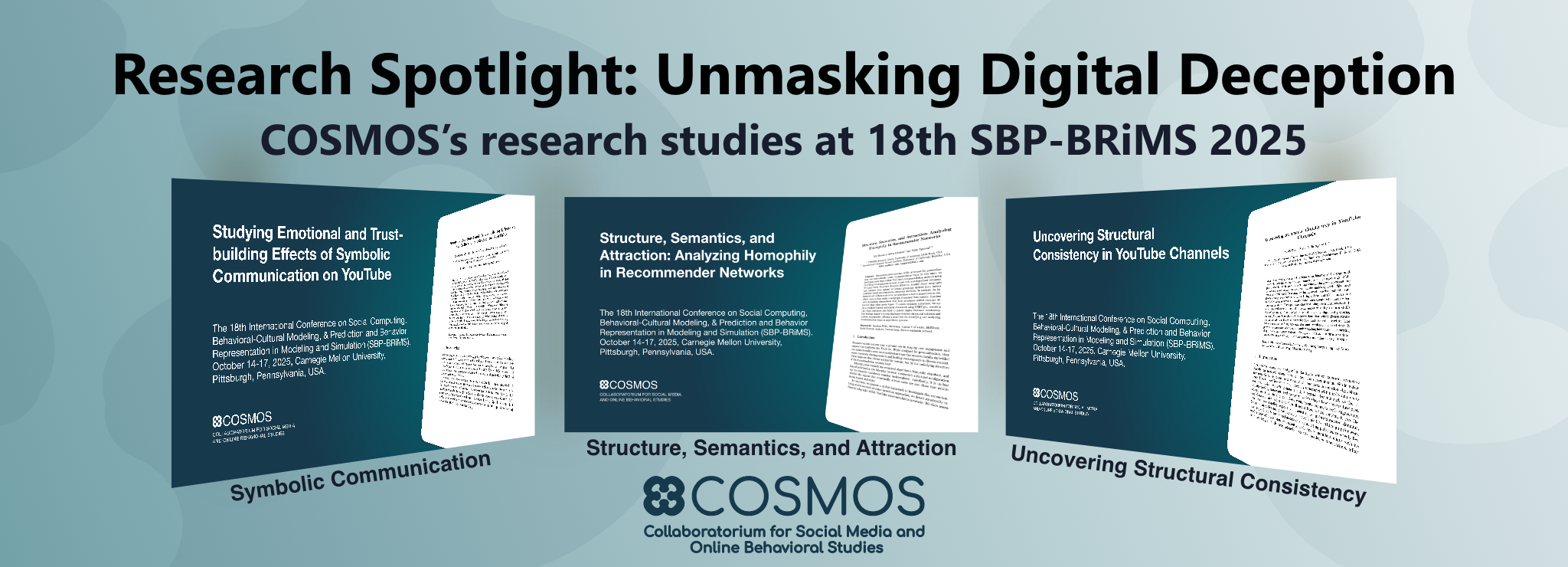
COSMOS at UA Little Rock continues to push the boundaries of socio-computational research, unveiling three groundbreaking studies at the prestigious and highly interdisciplinary 18th International Conference on Social Computing, Behavioral-Cultural Modeling, & Prediction (SBP-BRiMS). Hosted at Carnegie Mellon University, this elite forum brings together global leaders in computer science and social behavioral modeling to address the world’s most pressing digital threats.
The study, entitled “Studying Emotional and Trust-building Effects of Symbolic Communication on YouTube,” analyzes Taiwan’s information campaigns. LLMs were used in the research to reveal that cultural symbols drive significantly higher emotional engagement and trust than non-symbolic content, proving that visual semiotics are critical to digital political discourse.
Another study, entitled “Structure, Semantics, and Attraction: Analyzing Homophily in Recommender Networks,” used Focal Structure Analysis (FSA) to identify dense network subgraphs on YouTube that act as behavioral “traps.” These structures exhibit high topical uniformity, effectively narrowing user exposure and reinforcing ideological silos.
The third study, entitled “Uncovering Structural Consistency in YouTube Channels,” proposed a new unsupervised framework that characterizes YouTube channels by the semantic alignment of their metadata (titles, descriptions) with actual transcripts. The study identified three distinct behavioral profiles, offering a scalable method to detect narrative misrepresentation without manual labeling.
While unique in their focus, from visual semiotics to network topology and metadata alignment, these studies collectively advance AI and Social Computing. While each paper addresses a unique facet of AI, i.e., from multi-modal signal processing to geopolitical modeling, they collectively advance our ability to secure the socio-cognitive domain. COSMOS’s contributions at SBP-BRiMS highlight a unified mission: bridging the gap between social science theory and advanced machine learning to build community resilience.
By integrating Large Language Models (LLMs) with traditional network analysis, COSMOS is building the tools necessary to understand and mitigate harmful behaviors, ensuring transparency and resilience in our increasingly complex social-cyber world. By pioneering these socio-computational approaches, COSMOS is not only advancing the state-of-the-art in AI and YouTube forensics but is also providing policymakers and technologists with the tools needed to mitigate harmful behaviors and neutralize coordinated cognitive threats in our increasingly complex digital world.