
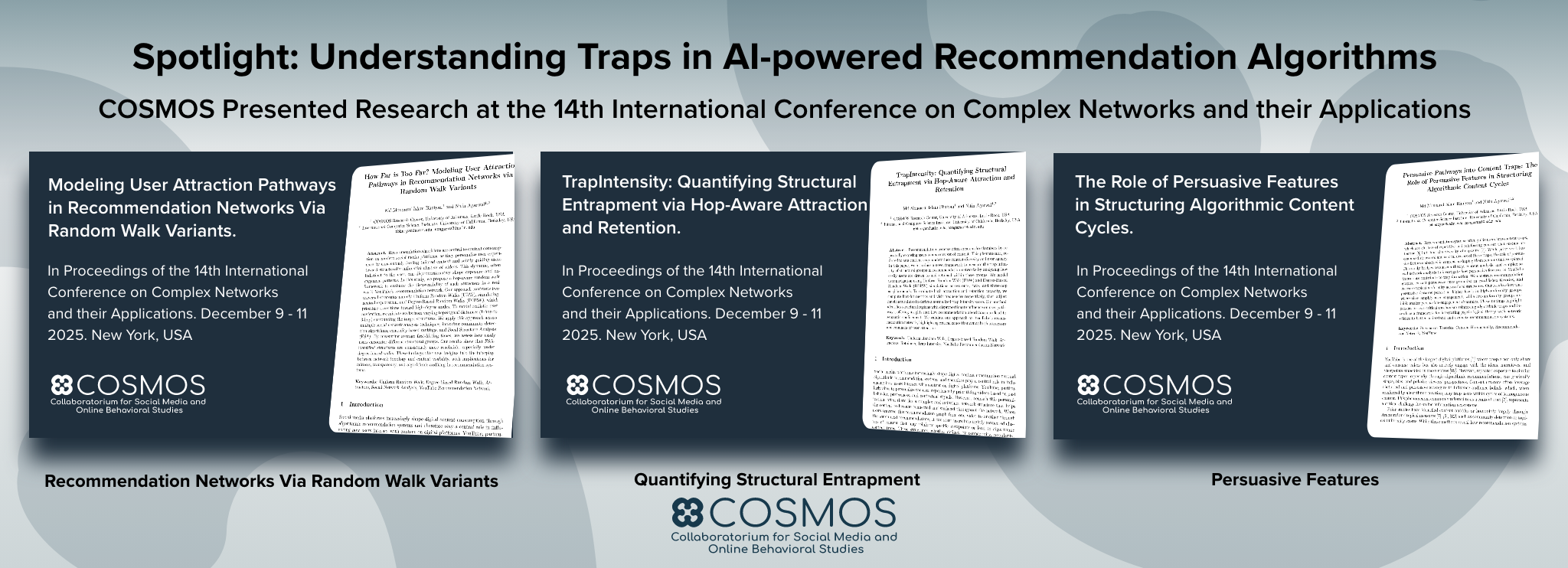
In this month’s research spotlight, COSMOS highlights three studies published at the 14th International Conference on Complex Networks and their Applications (Complex Networks), held in New York, USA, that investigate how recommendation systems shape user attention, content visibility, and online behavior. As users move from one recommended video to another, digital platforms can quietly nudge them toward tightly connected clusters of content. These clusters, often described as content traps, may narrow exposure, reinforce specific viewpoints, and steer attention towards (or away from) certain narratives or topics.
The first study, “How Far is Too Far? Modeling User Attraction Pathways in Recommendation Networks via Random Walk Variants,” examines how easily users can encounter structurally influential groups within a YouTube recommendation network. Using hop-aware random walk simulations, the study models how users may move from different distances in the network and compares neutral exploration with popularity-driven navigation. The study shows that certain focal structures are more reachable than other network groupings, offering insight into how recommendation pathways can make some content clusters more visible than others.
The second study, “TrapIntensity: Quantifying Structural Entrapment via Hop-Aware Attraction and Retention,” builds on this idea by asking not only whether users can reach a content cluster, but also how strongly that cluster can hold attention. The framework combines attraction and retention into a unified trap intensity score, helping identify network regions that are both easy to enter and difficult to leave. This offers a more interpretable way to study content traps, echo chambers, and filter bubbles in recommendation systems.
The third study, “Persuasive Pathways into Content Traps: The Role of Persuasive Features in Structuring Algorithmic Content Cycles,” looks beyond network structure to examine the content itself. The research investigates how persuasive features in YouTube transcripts interact with topical uniformity and engagement. The study finds that highly homogeneous content groups tend to contain stronger persuasive signals and higher engagement, suggesting that content traps are not only structural but also rhetorical. In other words, users may remain in these cycles not just because of how recommendations are connected, but because the content itself is persuasive and reinforcing.
Together, these studies tell a broader story about algorithmic influence. AI-based recommendation systems do more than suggest content; they shape pathways of influence and attention. By combining network science, random walk modeling, persuasion theory, and engagement analysis, our research advances new ways to understand how content traps form, why they persist, and how they can be studied more transparently. Collectively, it reflects COSMOS’s mission to develop robust, interpretable, and socially meaningful approaches for analyzing digital ecosystems. For science, it contributes new methods for auditing recommendation networks and modeling user exposure. For society, it supports a deeper understanding of how online platforms and their AI-based algorithms can influence information diversity, user agency, and the dynamics of digital behavior.