
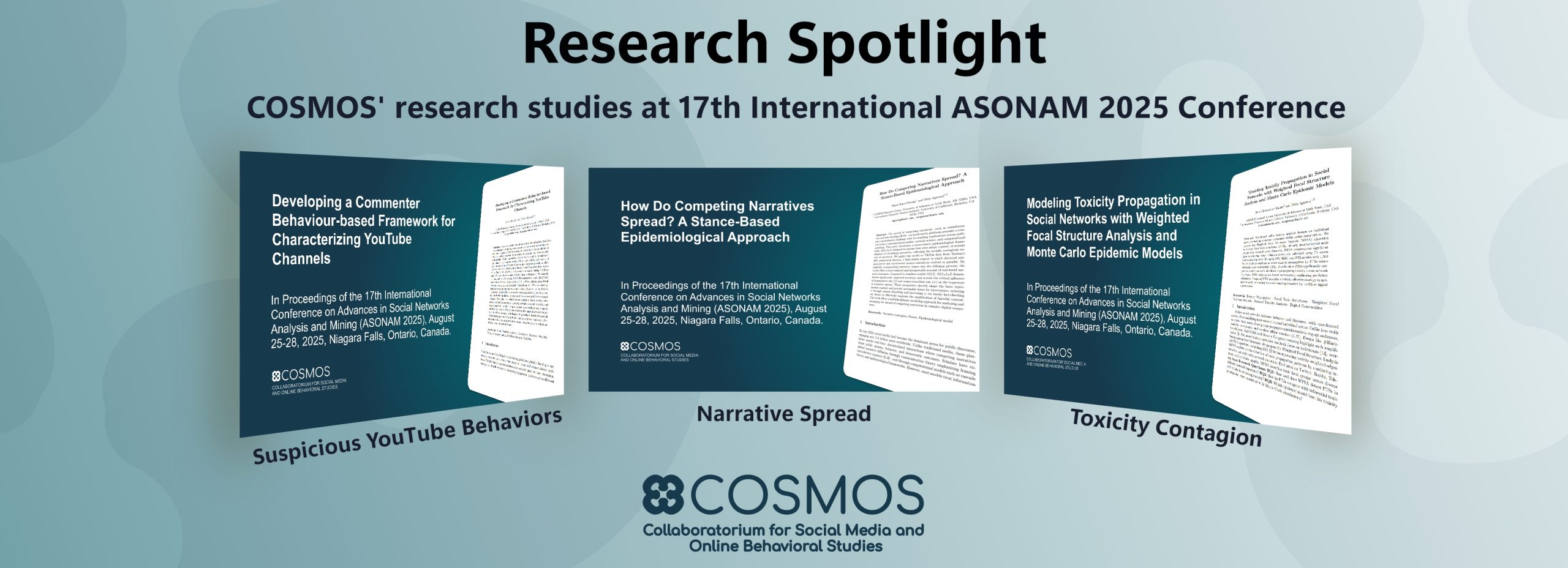
At the 17th International Conference on Advances in Social Networks Analysis and Mining (ASONAM 2025) in Niagara Falls, Ontario, COSMOS showcased ten groundbreaking studies. In this edition, we discuss three of these studies that advance our understanding of diffusion dynamics of competing narratives, anomalous behaviors in YouTube online communities, and toxicity contagion in digital environment.
The first study, Developing a Commenter Behavior-based Framework for Characterizing YouTube Channels, shifts focus from video content to audience engagement. This research demonstrates how analyzing patterns in commenter behavior, such as frequency of participation, co-commenting networks, and engagement styles, can uncover hidden structures of influence. By applying this framework to large datasets of channels, videos, and comments, the study identifies coordinated “commenter mobs” and patterns that differentiate authentic communities from those that are manipulative or harmful. This behavioral perspective opens new avenues for detecting influence operations and safeguarding online discourse.
Another contribution: How Do Competing Narratives Spread? A Stance-Based Epidemiological Approach introduces a compartmental modeling framework that integrates stance detection into epidemiological analysis. Instead of treating all information as equal, this model accounts for how audiences align with narratives, whether supportive, oppositional, or skeptical. By incorporating stance, the study captures the competitive dynamics between conflicting narratives, revealing how dominance shifts over time and how polarization shapes information flows. The approach provides valuable insights for anticipating which narratives are likely to persist and how interventions might influence their trajectory.
The third study, Modeling Toxicity Propagation in Social Networks with Weighted Focal Structure Analysis and Monte Carlo Epidemic Models, advances the science of understanding how harmful content spreads. By integrating weighted focal structure analysis with Monte Carlo epidemic simulations, the research identifies how toxic behaviors originate and accelerate through influential subgroups in networks. The findings highlight structural vulnerabilities where toxicity is most likely to amplify and propose strategies for intervention that target key nodes or clusters to slow or disrupt toxic discourse’s diffusion.
We will discuss the other seven studies in our future editions of COSMOS newsletters. These studies span theory, data-driven analysis, and simulations, converging on a central theme: how influence, trust, symbols, emotions, recommender systems, and toxicity shape narratives and influence campaigns in online spaces and user experiences.
Together, these studies underscore COSMOS’s leadership in computational social science, blending epidemiological modeling, behavioral analytics, and network science to confront some of the most pressing challenges in today’s online environments, providing insights that can inform safer, fairer, and more resilient information environments.