
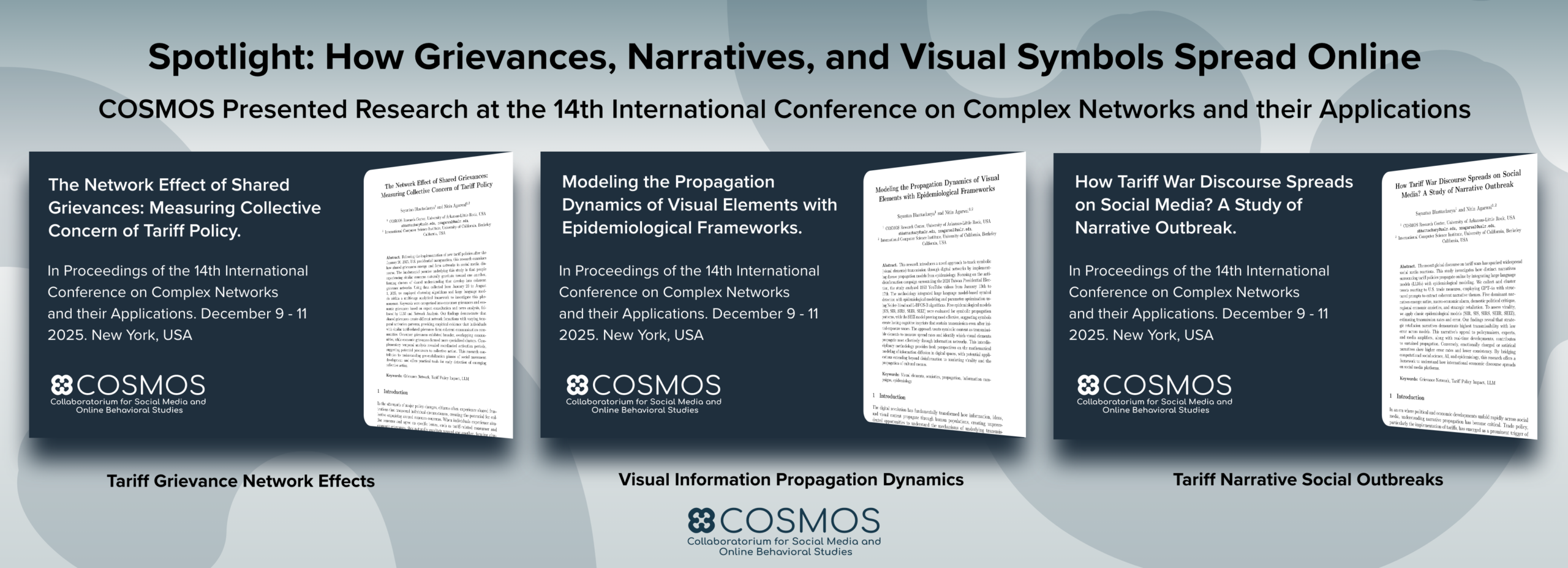
In this month’s research spotlight, COSMOS highlights three studies presented at the 14th International Conference on Complex Networks and their Applications in New York, USA, exploring the underlying mechanics of digital influence, grievance clustering, and narrative transmission. When major geopolitical events unfold, social media platforms function as dynamic information ecosystems where personal reactions can swiftly evolve into structured movements. Understanding how everyday concerns translate into connected communication networks, which policy storylines achieve sustained reach, and how visual symbols drive engagement is crucial for deciphering modern collective behavior.
The first study, “The Network Effect of Shared Grievances: Measuring Collective Concern of Tariff Policy,” examines how tariff-related grievances mobilize online communities. Using a multi-stage framework that integrates GPT-4o-mini classification, HDBSCAN clustering, and user-mention networks across six months of data, the authors analyzed the structural divergence between consumer and economic grievances. The results reveal that tangible consumer hardships form broad, overlapping clusters with fluid boundaries that experience sudden, synchronized surges around external triggering events. In contrast, macroeconomic concerns organize into dense, specialized clusters centered on specific trade sectors and policy figures, demonstrating how online grievance networks form the pre-mobilization groundwork for broader collective action.
The second study, “Modeling the Propagation Dynamics of Visual Elements with Epidemiological Frameworks,” introduces a novel computational approach to track how visual symbols spread across video platforms during information manipulation in Taiwan. Utilizing the PRISM color-shift model to extract key video frames alongside vision-language models for symbol classification, the authors evaluated five epidemiological models to trace symbol dissemination across nearly 2,000 YouTube videos. The SEIZ framework, which explicitly accounts for an undecided or skeptical audience compartment, achieved the highest fidelity by dropping modeling error to 0.45%. Crucially, the findings show that transmission effectiveness does not depend on symbol saturation, but rather on strategic pairing, with political symbols and dual-symbol combinations achieving near-optimal viral spread.
The third study, “How Tariff War Discourse Spreads on Social Media? A Study of Narrative Outbreak,” bridges qualitative narrative analysis with mathematical epidemiology to track competing storylines during international trade disputes. By clustering multilingual Twitter discourse and applying GPT-4o with structured prompts, the authors extracted five core narratives and modeled their transmission rates using bounded parameter optimization algorithms, including Nelder-Mead and L-BFGS-B. The analysis found that analytically grounded narratives, specifically those focused on reciprocal tariffs, strategic retaliation, and institutional trade responses, consistently demonstrated the highest transmissibility and lowest error. Meanwhile, emotionally charged and satirical narratives exhibited volatile decay, proving that policy-rich, expert-amplified content sustains longer digital lifespans.
Together, these studies advance COSMOS’s mission to build robust, interpretable approaches for analyzing complex digital ecosystems. For science, they bridge mathematical diffusion models with qualitative narrative extraction and AI-enhanced computer vision, offering scalable methodologies to audit information flows. For society, they provide platform owners, researchers, and policymakers with actionable diagnostic tools to identify emerging collective narratives, evaluate visual campaigns, and anticipate the trajectory of contentious public discourse.