
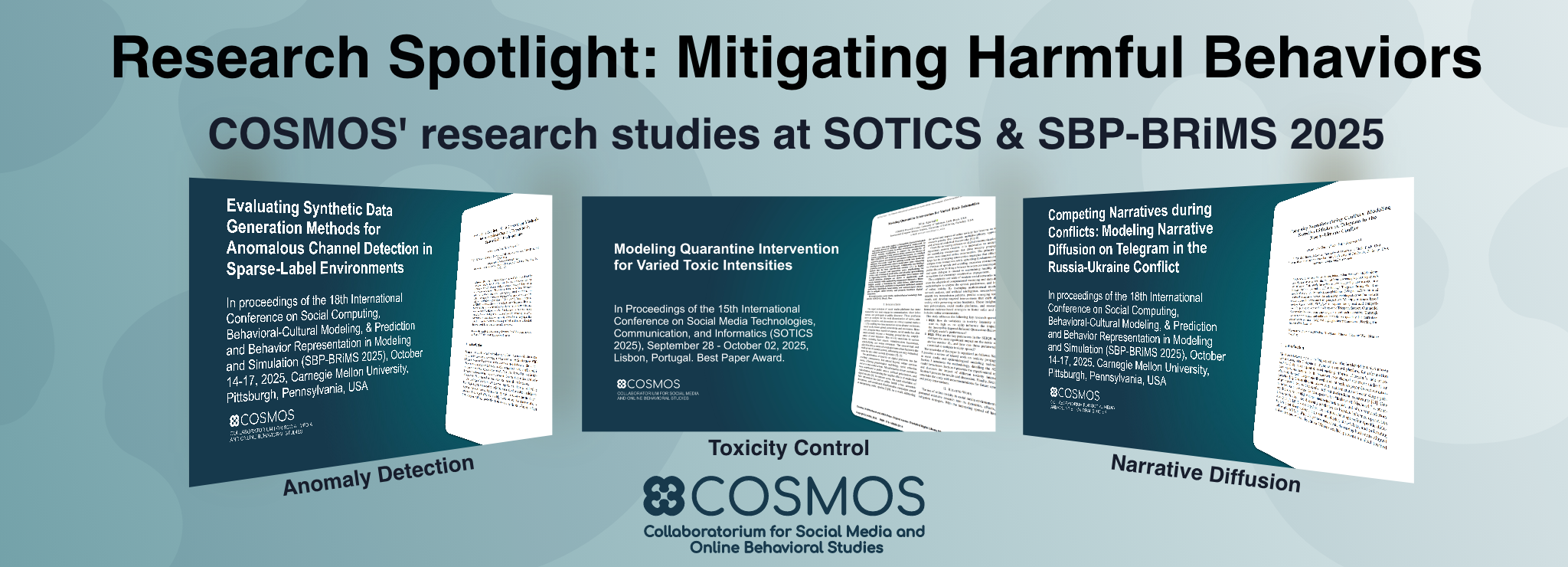
This edition features three of our peer-reviewed studies published in leading international conferences on social computing, focusing on information diffusion, anomaly detection under data scarcity, and intervention strategies for mitigating harmful online behavior in complex networked systems.
The first study, “Modeling Quarantine Intervention for Varied Toxic Intensities,” presented at The Fifteenth International Conference on Social Media Technologies, Communication, and Informatics (SOTICS 2025) in Lisbon, Portugal, explores how quarantine-based interventions can reduce the spread of toxic content online. By extending an epidemiological SEIQR framework, the study demonstrates that targeted, toxic intensity-aware quarantine strategies significantly outperform uniform moderation approaches while preserving user engagement. In recognition of its originality, rigor, and impact, this paper was recognized with the Best Paper Award at SOTICS 2025.
The other study, titled “Competing Narratives during Conflicts: Modeling Narrative Diffusion on Telegram in the Russia–Ukraine Conflict,” presented at the 18th International Conference on Social Computing, Behavioral-Cultural Modeling, & Prediction (SBP-BRiMS 2025) in Carnegie Mellon University, Pittsburgh, Pennsylvania, USA, investigates how competing pro-Kremlin and pro-Ukrainian narratives propagate on Telegram during an active geopolitical conflict. Using a stance-based epidemiological diffusion model, the study captures how rival narratives compete for attention and quantifies the structural and temporal factors that shape their spread, offering insights into information warfare dynamics on minimally moderated platforms.
The third study, titled “Evaluating Synthetic Data Generation Methods for Anomalous Channel Detection in Sparse Label Environments,” published in the proceedings of the 18th International Conference on Social Computing, Behavioral-Cultural Modeling, & Prediction (SBP-BRiMS 2025) in Carnegie Mellon University, Pittsburgh, Pennsylvania, USA, addresses the challenge of detecting anomalous YouTube channels when labeled data is scarce. The study systematically evaluates multiple synthetic data generation techniques and demonstrates that models trained on high-quality synthetic data can substantially improve anomaly detection performance in low-resource settings.
Prof. Agarwal stated that, “taken together, these studies highlight the effectiveness of mathematical modeling and data-driven approaches in understanding and managing complex social and information systems, particularly in high-stakes, adversarial, and data-constrained environments.”