
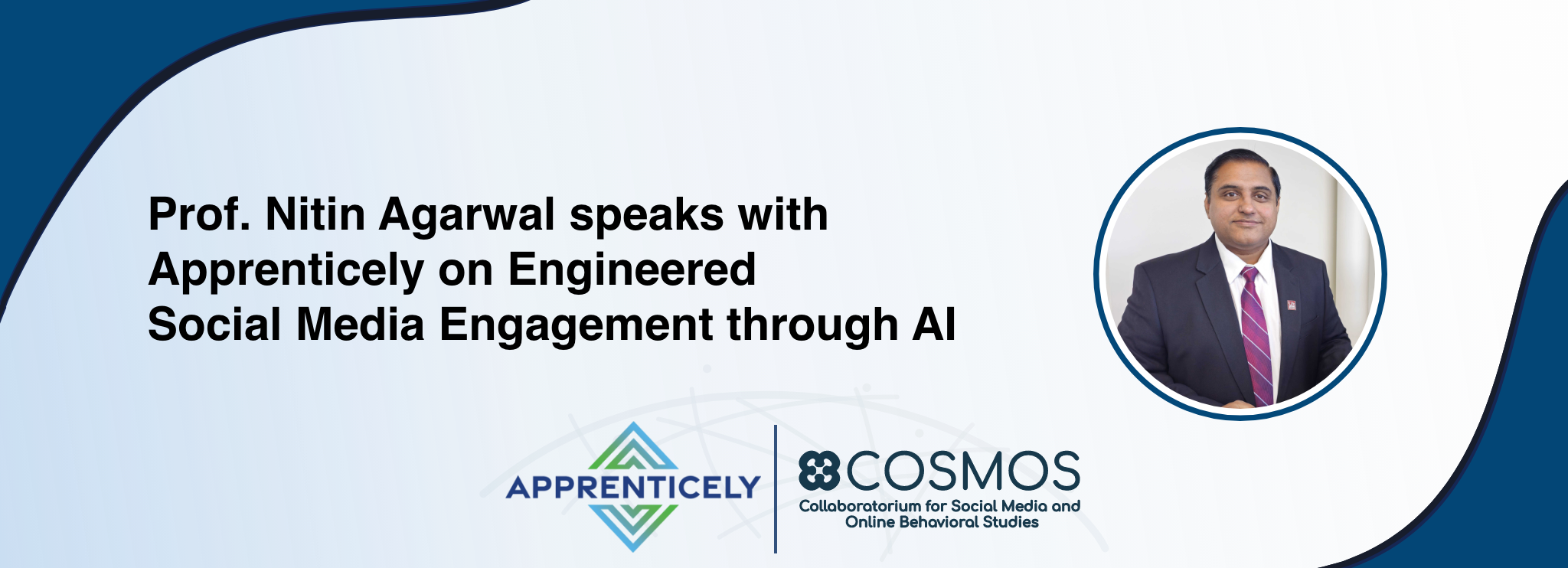
In a recent Q&A feature published by Apprenticely, COSMOS Research Center director Prof. Nitin Agarwal reflected on a milestone judicial verdict holding tech giants Meta and YouTube liable for negligent, addictive platform design. The landmark ruling brings sweeping scrutiny to how major social media platforms operate, shifting public and legal focus toward the engineered mechanisms that drive modern digital environments.
Prof. Agarwal explained that social media algorithms are fundamentally optimized for attention maximization and engagement rather than user well-being. Powered by AI recommender systems, platforms leverage psychological triggers such as variable rewards, social validation, and the fear of missing out (FOMO). Features like infinite scroll and continuous autoplay intentionally strip away natural stopping cues, creating repetitive feedback loops that reinforce compulsive behavior. Because time-on-platform directly translates into advertising revenue, user retention is not an unintended side effect, but rather an explicitly engineered outcome.
Beyond individual psychological impacts, COSMOS’s research demonstrates how these platform vulnerabilities scale socially and politically. Supported by over $30 million in project funding from federal agencies, including the U.S. Department of War and the National Science Foundation, COSMOS studies how algorithms shape collective human behavior during crises and socio-political events. Adversarial actors routinely exploit these engagement-first models by deploying bots, coordinated posting, and outrage-driven content to game recommendation systems. By weaponizing human psychology and platform design, malicious actors effectively turn content curation algorithms into vectors for large-scale cognitive influence and disinformation.
Comparing these recent legal developments to the historical scrutiny faced by Big Tobacco, Prof. Agarwal outlined a potential path forward for tech regulation. As internal corporate knowledge and design intents come under increased judicial review, platforms may face mandatory duty-of-care standards, age protections for minors, and structural requirements for algorithmic transparency. Highlighting Arkansas Governor Sarah Huckabee Sanders’s initiative to tackle youth exposure and online harms, Prof. Agarwal noted growing momentum among policymakers. Serving as a member of the Governor’s AI Taskforce, he suggested that future AI systems could be reoriented away from pure attention harvesting and toward healthy engagement, fostering a more accountable and resilient digital ecosystem.
Click here to read the full Q&A feature on Apprenticely.