
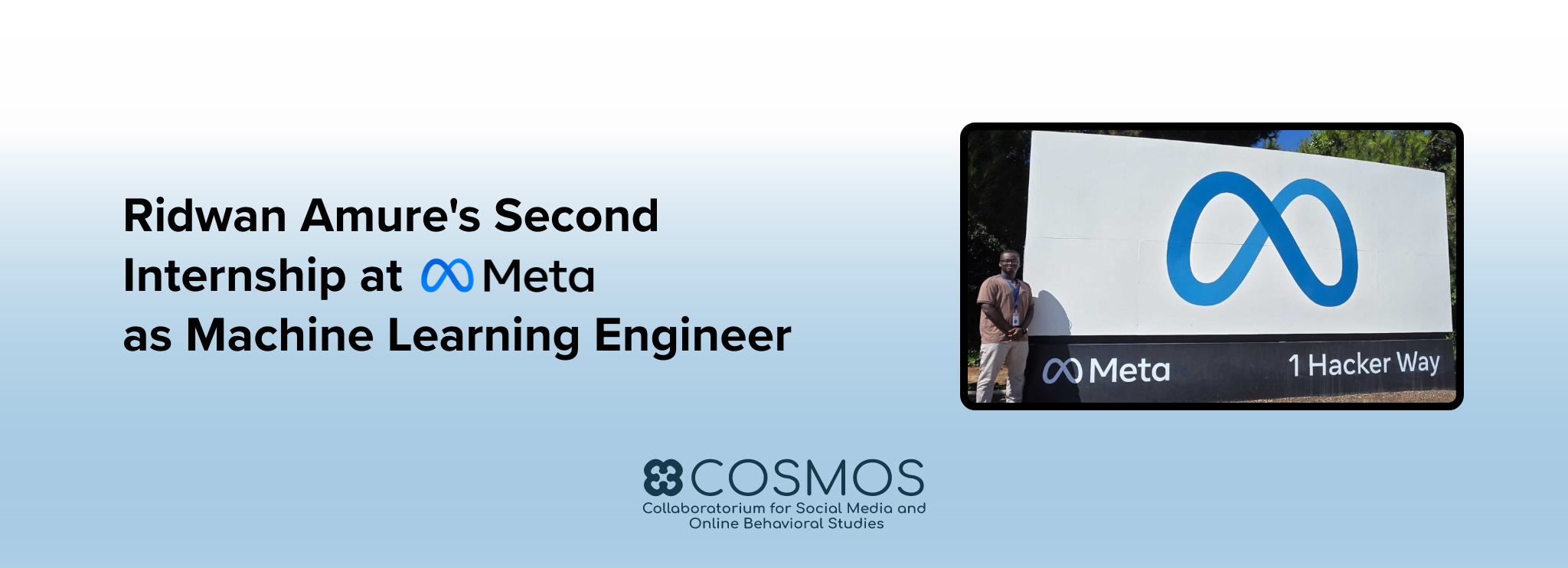
Where did you complete your internship, and what was the primary focus of your projects?
I did my summer internship at Meta, Inc. (parent company of Facebook), where I worked on developing “Early Stage Ranking Models” for Product Centric Ads (Recommendation Systems)
What skills did you develop, what challenges did you face, and what was your most valuable takeaway from the experience?
During my internship, I developed skills in ranking systems, machine learning experimentation, model evaluation, and production-focused AI. The main challenge was learning how to build under real production constraints, such as scale and latency. My biggest takeaway was that strong ML solutions must be accurate, efficient, and practical for real-world deployment. This experience showed me how machine learning research becomes useful when it can work reliably in a real production system.
In what ways did your COSMOS research experience prepare you for your internship?
I work as a graduate assistant at the COSMOS Research Center under Prof. Nitin Agarwal’s supervision on projects that honed my skills in social computing, behavioral modeling, machine learning, AI, large-scale data analysis, and model evaluation. Prof. Agarwal is also my doctoral advisor and dissertation chair. His mentorship enabled me to conduct competitive, team-oriented, and application-driven research. He encourages us to publish at top-tier venues. These skills helped me tremendously during my internship at Meta, a highly competitive and mission-driven environment.
How has your internship experience enhanced your current work and research at COSMOS?
My internship influenced how I think about our research at COSMOS. It helped me see the value of building models that are not only accurate but also efficient, scalable, and useful in real-world applications. I now bring this practical view into the research project led by Prof. Agarwal at the COSMOS Research Center.
How did your internship broaden your perspective on the type of research conducted at COSMOS?
My internship broadened my view of research conducted at COSMOS. At COSMOS, we study how user connections on social media shape social behavior from outside the platforms. At Meta, I studied these behaviors from within the platform. Specifically, I analyzed how similar user-item and user-content connections can be used to support recommendation systems. This helped me see that the same research ideas can apply to both social analysis and product systems. Further, I recognize the need for an application-oriented approach to research – something that Prof. Agarwal consistently champions.
What advice would you offer to fellow COSMOS researchers preparing for future internships?
Be steadfast. Work hard. Learn as much as you can. Know your research and its value to society. No shortcuts. Listen to Prof. Agarwal!
Share a memorable story or moment from your internship that stood out to you.
One memorable moment was when one of my peer leads went on a refresh, and I had to help set up a war room with senior engineers. It was an eye-opening experience because I had to respond quickly, organize the work, communicate clearly, and solve technical problems under pressure. The moment tested my engineering, leadership, and interpersonal skills.
If you had to describe your internship experience in one word, what would it be?
Incredible!