
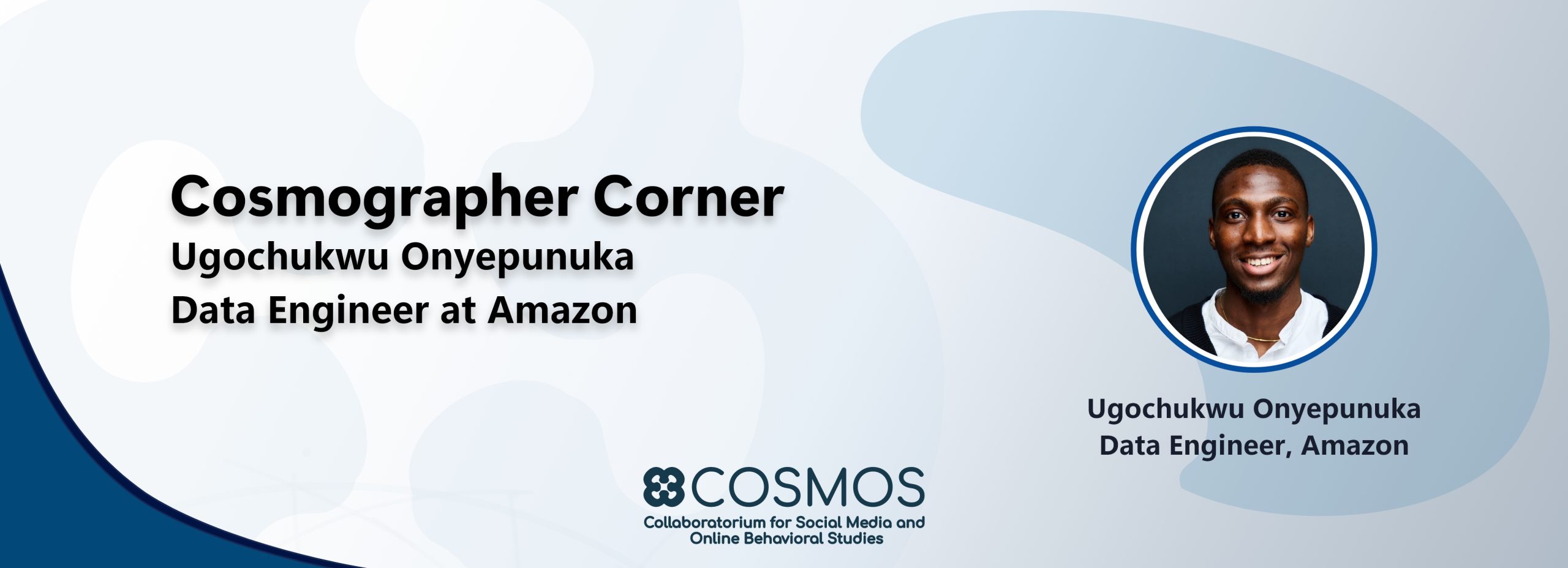
In this edition of Cosmographer Corner, we are pleased to highlight Ugochukwu Onyepunuka, a former graduate research assistant at COSMOS Research Center. He earned his Master of Science in Information Science department at the University of Arkansas at Little Rock. During his time at COSMOS, Ugochukwu made significant contributions to multiple research projects, particularly in developing and maintaining the YouTube data ingestion pipeline and evaluating algorithmic bias in social media recommender systems. His work involved collecting millions of data points daily through the YouTube API, troubleshooting system issues, and optimizing performance to support large-scale analysis.
Today, Ugochukwu serves as a Data Engineer at Amazon, a role he has held for nearly three years. His professional success continues to reflect the skills, values, and problem-solving mindset he cultivated at COSMOS.
“I am proud of the accomplishments and the many contributions Ugochukwu has made to the COSMOS Research Center. We celebrate his academic journey and wish him continued success at Amazon,” said Prof. Nitin Agarwal.
We recently connected with Ugochukwu to learn more about his current role, his experiences at COSMOS, and his advice for future Cosmographers.
How did COSMOS fit into your university/secondary education career? How did you come across COSMOS, and what were you studying when you joined COSMOS?
COSMOS played a pivotal role in shaping my academic and professional journey. It provided me with my first real exposure to structured research, from developing problem statements to applying research methodologies under the guidance of Dr. Agarwal. Beyond research, COSMOS gave me invaluable hands-on experience with large-scale data processing, particularly ingesting, transforming, and maintaining ETL pipelines across platforms like YouTube and Twitter. This experience introduced me to the challenges and practices of data engineering, helping me understand what it means to scale and sustain data pipelines effectively.
The environment at COSMOS also pushed me out of my comfort zone by involving me in research publications and new challenges, broadening both my technical skills and academic perspective.
At the time, I was studying Information Science. I first learned about COSMOS while working at a health informatics company in Nigeria, where a close friend’s brother had been part of COSMOS and shared the impact it had on his career. Intrigued, I researched the center’s work on social computing and soon discovered that a secondary school and undergraduate colleague of mine was also a COSMOS alumnus. Through these connections, I reached out to Dr. Agarwal, expressed my interest, and was fortunate to join. Since then, COSMOS has been an enriching and transformative part of my higher education and career development.
How did COSMOS contribute to your career and program at UALR? What was Dr. Agarwal’s role in your journeys during and after?
COSMOS contributed significantly to both my academic program and career development at UA Little Rock. As an Information Science student, the hands-on research experience I gained at COSMOS gave me an edge in my coursework. For example, even before taking formal classes like Social Computing, I had already worked with concepts such as network analysis and large-scale data processing through my projects at COSMOS. This practical exposure made coursework feel much more manageable and allowed me to apply classroom theories with confidence. Beyond academics, working with COSMOS trained me to approach problems methodically, starting from a problem statement, applying appropriate techniques, and communicating results effectively through research papers. These experiences not only built my technical expertise but also strengthened my communication, writing, and problem-solving skills, which prepared me well for my career.
Dr. Agarwal played an invaluable role throughout this journey. His deep expertise in social computing, his problem-solving approach, and his presentation style were inspiring models for me to learn from. He is an excellent mentor who guided my research and helped me develop both technically and professionally. Even after my time at COSMOS, Dr. Agarwal has been supportive, providing recommendations and advice whenever needed, which I deeply appreciate.
How would you describe the “research pipeline” that you worked on while at COSMOS?
During my time at COSMOS, my research focused primarily on YouTube. I worked on the data ingestion pipeline, which involved collecting millions of data points daily through the YouTube API, maintaining the system, troubleshooting failures, and optimizing performance. My specific research examined whether YouTube’s recommendation algorithm could exhibit bias and potentially be leveraged by actors to spread propaganda or narratives. In one project, we started with a set of 50 videos across different topics and tracked recommendations over multiple hops to see if they converged toward a particular theme. We observed implicit tendencies in the algorithm that leaned toward certain narratives. This work gave me valuable experience in auditing recommendation systems and exploring the role of bias in online information environments.
Since leaving COSMOS, what roles/positions/jobs have you had? What is your current work? What positions did COSMOS and your classes at UALR best prepare you for?
Since leaving COSMOS, I have been working as a Data Engineer at Amazon for nearly three years. In my current role, I work closely with stakeholders such as product managers, data scientists, and software engineers to gather requirements, design data models, and build ETL pipelines that process large volumes of data. I have also contributed to building multiple data platforms across different teams at Amazon.
COSMOS and my coursework at UA Little Rock prepared me exceptionally well for this role. The hands-on experience with large-scale data pipelines at COSMOS gave me a strong technical foundation, while the process of writing and publishing research papers sharpened my communication and documentation skills critical for explaining complex technical work to diverse audiences. Additionally, balancing coursework with COSMOS research taught me how to manage competing priorities under pressure while still delivering high-quality results.
If you had to describe the most momentous event at COSMOS, what would it be? (Such as a specific conference you presented at, or a specific paper presented, or a project you worked on.)
One of the most memorable aspects of my time at COSMOS was the Friday meetings. After each meeting, we would return to the lab and continue conversations discussing research, coursework, and even life. Those moments built a strong sense of community, and I truly valued the friendships and collaborations that came out of them.
Another momentous event was when my paper was accepted to the Text to Story conference. After all the hard work, receiving that acceptance and having Dr. Agarwal announce it during a Friday meeting was an incredibly rewarding and motivating experience.
What advice would you have for current Cosmographers? (Such as looking for conferences to present at, jobs to apply for, and recommending fields that social computing research/skills can be applied to.)
My advice to current Cosmographers is to fully embrace the opportunities that COSMOS offers, even if the workload feels demanding at times. The skills and experiences you gain will continue to benefit you long after you leave. Work closely with your teammates, build strong relationships, and actively network within the lab to explore new ideas and collaborations. The connections you make and the knowledge you acquire will be invaluable throughout your academic and professional journey.
Working with Prof. Agarwal means entering a space where bold ideas turn into real possibilities. His leadership inspires confidence and growth, encouraging you to uncover talents you never realized you had. At COSMOS, you join a purpose-driven community where every contribution shapes meaningful change. Embrace it and leave a mark!