
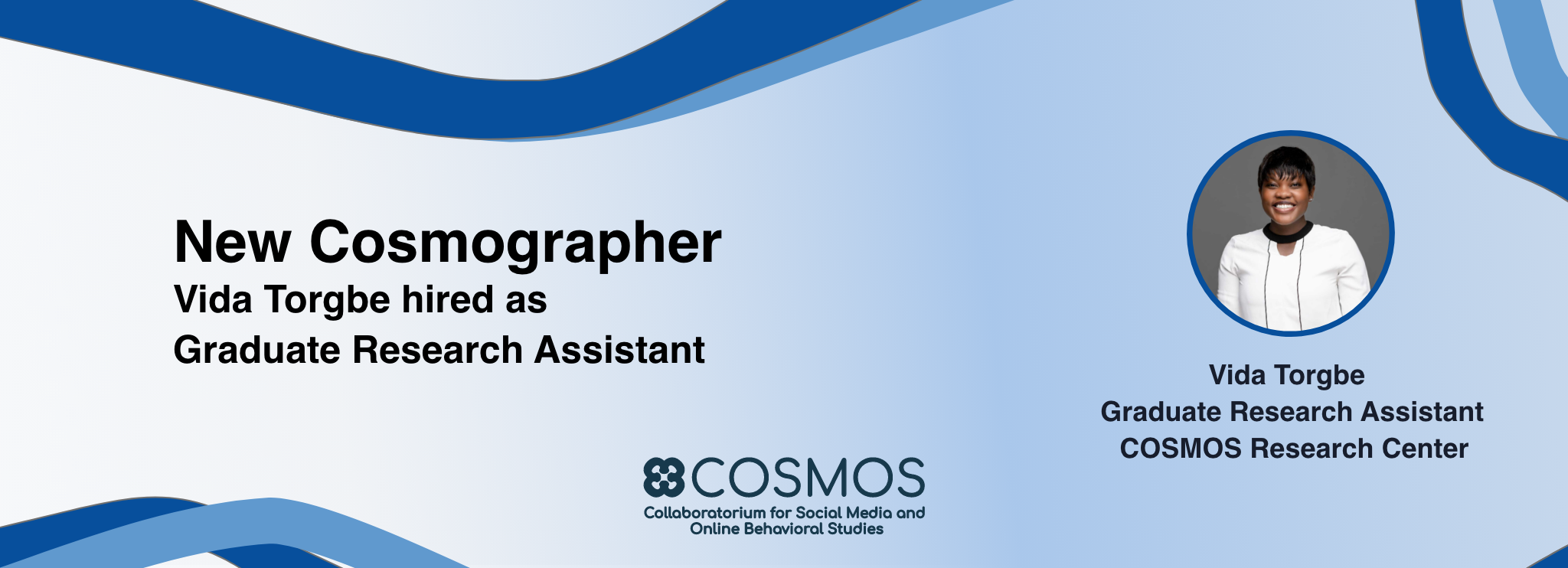
What role do you play at COSMOS?
At COSMOS, I work as a Graduate Assistant, helping Prof. Agarwal with projects focused on understanding social media behaviors. My work involves helping with conducting experiments to evaluate hypotheses. Additionally, I contribute to the center’s communication efforts.
Please share a bit about your professional background and experience.
I have a multidisciplinary background in social sciences and data science, with experience in program evaluation, data analysis, and monitoring and evaluation. I hold a Master of Public Service and am currently pursuing a Master of Science in Information Science at UA Little Rock. My professional experience includes policy research with the Arkansas Department of Education, data analysis with nonprofit organizations, and supporting UNICEF and World Bank social protection initiatives through data-driven monitoring and evaluation.
What attracted you to join the COSMOS Research Center? What aspects of COSMOS’s vision, mission, and culture stood out to you and why?
What drew me to COSMOS was Prof. Agarwal’s focus on using data science and social media analytics to understand real-world cyber behaviors. Prof. Agarwal’s vision of leading high-impact, multidisciplinary research perfectly aligns with my desire to apply my data science training to meaningful societal issues. It is inspiring to see in the news that Prof. Agarwal and COSMOS are widely recognized as global leaders in social media research, earning international awards for tracking algorithmic bias, combating misinformation, and uncovering narrative manipulation on platforms like YouTube. The culture at COSMOS also stood out to me because it encourages team members from different backgrounds to collaborate and solve these complex problems together.
How do you anticipate your role at COSMOS helping your growth on both a personal and professional level? Are there any specific skills or experiences you’re looking to gain?
At COSMOS, I hope to strengthen my skills in social media analytics, data preprocessing, Python, data visualization, and UI development, as these are core requirements for all COSMOS projects led by Prof. Agarwal. I’m also eager to gain a deeper understanding of tools such as BlogTracker and vTracker and how their data pipelines and interfaces work together. Working under Prof. Agarwal’s guidance will also give me valuable exposure to interdisciplinary research and help me grow as both a researcher and a technical professional.
From your experience, what tips, insights, or advice would you share with someone starting a new role at COSMOS?
My biggest piece of advice would be to fully embrace the collaborative nature of the lab and never hesitate to ask questions. Because COSMOS brings together people from so many different academic backgrounds, there is a wealth of knowledge all around you. A great way to tap into that is to pay attention during the daily huddles when cosmographers share updates on the projects and tasks they are working on.
If you could share a meal with any historical figure or fictional character, who would it be, and what would you want to talk about and learn from them?
I would choose to share a meal with Maya Angelou. Having worked closely with the Celebrate Maya Project in Little Rock, I have developed a deep appreciation for her legacy, resilience, and profound ability to capture the human experience. During our conversation, I would love to connect my background in public service and a strong desire for social media analysis with her unique perspective on community engagement. I would want to talk to her about how we can best use modern data tools and technology to uncover societal needs, tell authentic stories, and shape public policies that protect vulnerable populations.