
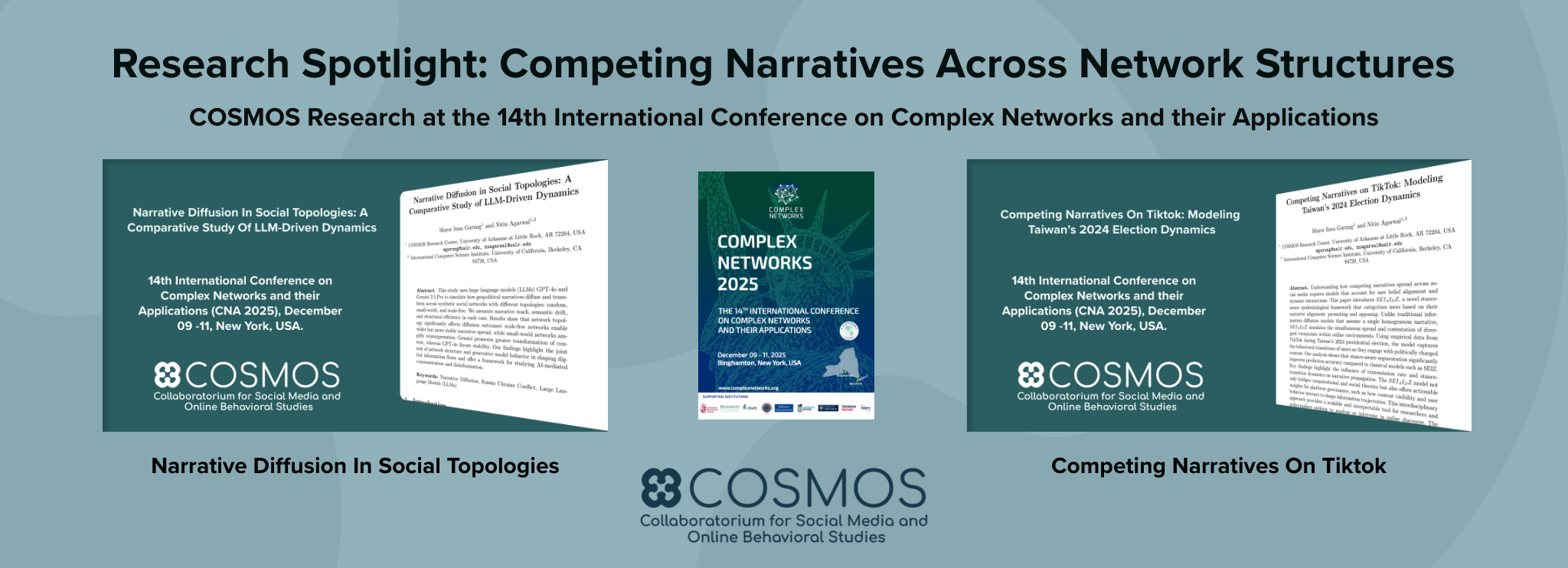
COSMOS Research Center continues to push the boundaries of socio-computational research, unveiling two groundbreaking studies at the prestigious 14th International Conference on Complex Networks and their Applications (Complex Networks), New York, USA. This conference brings together global leaders in computer science and network modeling to address the world’s most pressing digital threats.
The first study, entitled “Competing Narratives on TikTok: Modeling Taiwan’s 2024 Election Dynamics,” examines how conflicting storylines spread and compete, using empirical data from TikTok during Taiwan’s 2024 presidential election. Introducing a novel stance-aware epidemiological framework, the authors categorized users based on whether they actively promote, oppose, or remain skeptical of a narrative. By modeling this ideological resistance, the authors achieved significantly higher predictive accuracy compared to classical and non-stance-aware contagion tracking models. Overall, the results demonstrate that incorporating user stance significantly improves the prediction of narrative virality, revealing that raw transmission speed and the time it takes for users to shift their beliefs are the true engines of online spread.
The second study, entitled “Narrative Diffusion in Social Topologies: A Comparative Study of LLM-Driven Dynamics,” investigates how geopolitical narratives regarding the Russia-Ukraine conflict diffuse and transform across synthetic social networks using Generative AI models. Using large language models like GPT-4o and Gemini 2.5 Pro, the analysis shows that a network’s underlying “shape” dictates a narrative’s fate: scale-free networks (hub-heavy platforms) maximize a story’s reach while keeping the original message highly stable, whereas small-world networks (tight-knit communities) restrict reach but heavily mutate the narrative’s meaning. The study also reveals that Gemini promotes greater creative transformation of content, whereas GPT-4o acts conservatively and favors stability. Overall, the findings suggest that the joint role of network structure and generative AI behavior critically shapes digital information flows, offering a new framework for studying AI-mediated information operations.
Both studies leverage advanced computational approaches to analyze digital communication, but they differ in focus and methodological emphasis. The narrative diffusion study applies advanced large language models to synthetic environments to interpret how content mutates as it flows through different network topologies. In contrast, the TikTok study employs mathematical epidemiological modeling against real-world video data to map how the ideological stances and active pushback of human users shape the trajectory of competing storylines.
Together, these studies demonstrate the power of social computing in uncovering nuanced patterns in digital communication, whether through structural network simulations or stance-aware user tracking. Scientifically, they advance methods for integrating generative AI behaviors and complex human belief states into information diffusion frameworks; societally, they offer actionable insights for platform governance, providing clear evidence that structural interventions like algorithmic throttling and rapid fact-checking are essential to mitigate harmful online campaigns.