
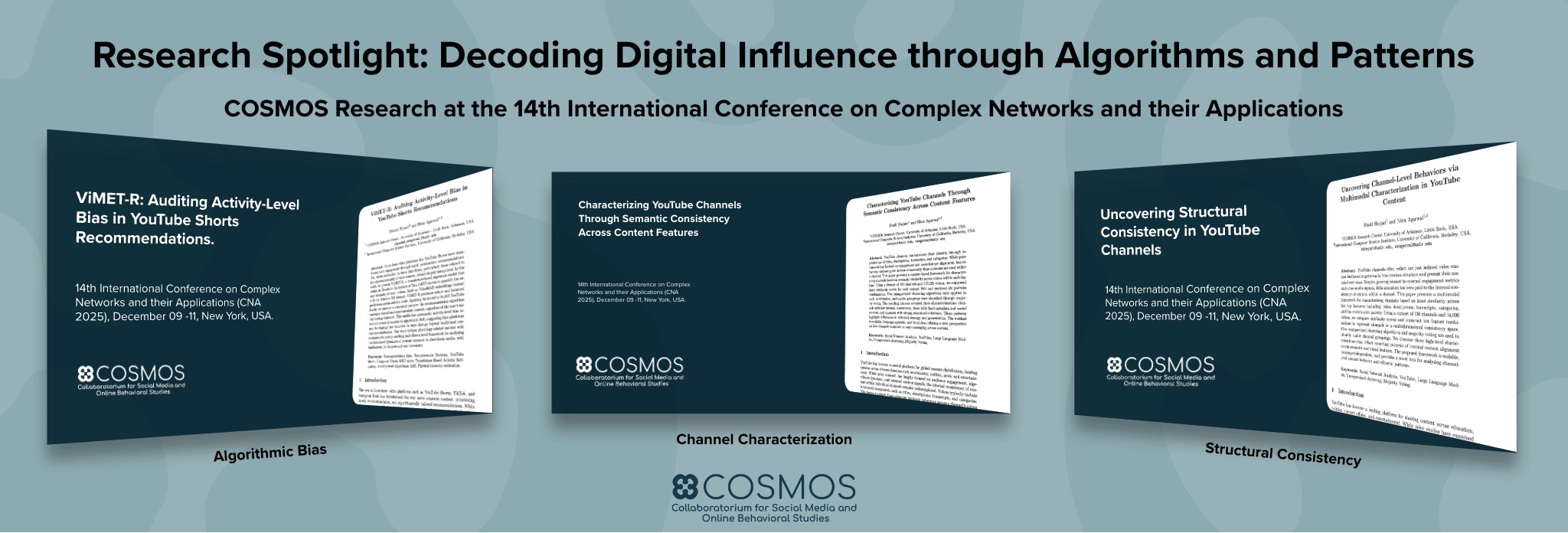
In this month’s research spotlight, COSMOS highlights its leadership in redefining digital media as an active force in shaping human behavior through three studies presented at the 14th International Conference on Complex Networks and their Applications (Complex Networks) in New York, USA. These studies examine the complex relationship between digital platforms, their algorithms, and content creators. While these research efforts all utilize large-scale auditing of YouTube content, they differ in their focus: one examines how platform algorithms shape user activity levels by pushing moderate-intensity content, while the others analyze how creators maintain internal consistency and coherence within their own channels.
The first study, “ViMET-R: Auditing Activity-Level Bias in YouTube Shorts Recommendations,” introduces ViMET-R, an advanced AI technique that visually estimates the physical energy expenditure of activities shown in videos using Metabolic Equivalent of Task (MET) scores.. By applying this model to 84,816 YouTube Shorts, the research uncovered a consistent pattern where the recommendation algorithm converges toward moderate-intensity content, regardless of the user’s initial viewing behavior. This systematic activity-level bias introduces a new dimension to algorithmic drift, suggesting that platforms may be shaping user behavior in ways that go beyond traditional content personalization.
The second study, “Uncovering Channel -Level Behaviors via Multimodal Characterization in YouTube Content,” presents a combined visual and text-based framework for characterizing YouTube channels by comparing similarity across five key features: titles, descriptions, transcripts, categories, and the video’s color palette. By evaluating 14,000 videos from 136 channels, the researchers identified three distinct editorial patterns: “Mild Visual Consistency, High Textual Variability”, “Category-Stable Channels”, and “Loosely Structured but Topically Focused Channels”. The findings demonstrate a scalable and language-independent method for uncovering stable channel groupings based on both visual and semantic features. This work offers a new lens for auditing channel-level behavior and understanding the patterns that shape long-term content strategies.
The third study, “Characterizing YouTube Channels Through Semantic Consistency Across Content Features,” introduces a content-based framework to analyze how YouTube channels communicate their identity through the consistent use of titles, descriptions, transcripts, and categories. By calculating how closely the text aligns (semantic similarity) across over 157,000 videos from 150 channels, the study identified three distinct editorial patterns: “Diverse-Format Channels”, “Label-Stable, Content-Variable Channels”, and “Structurally Cohesive Channels”. The findings reveal significant differences in how creators manage their messaging and presentation strategies over time.
These studies collectively imply that digital media is no longer just a passive platform but an active force in shaping human behavior and creator identity. These studies provide essential tools for auditing algorithmic fairness and understanding the long-term strategies that influence the information and physical activity levels we are exposed to daily.