
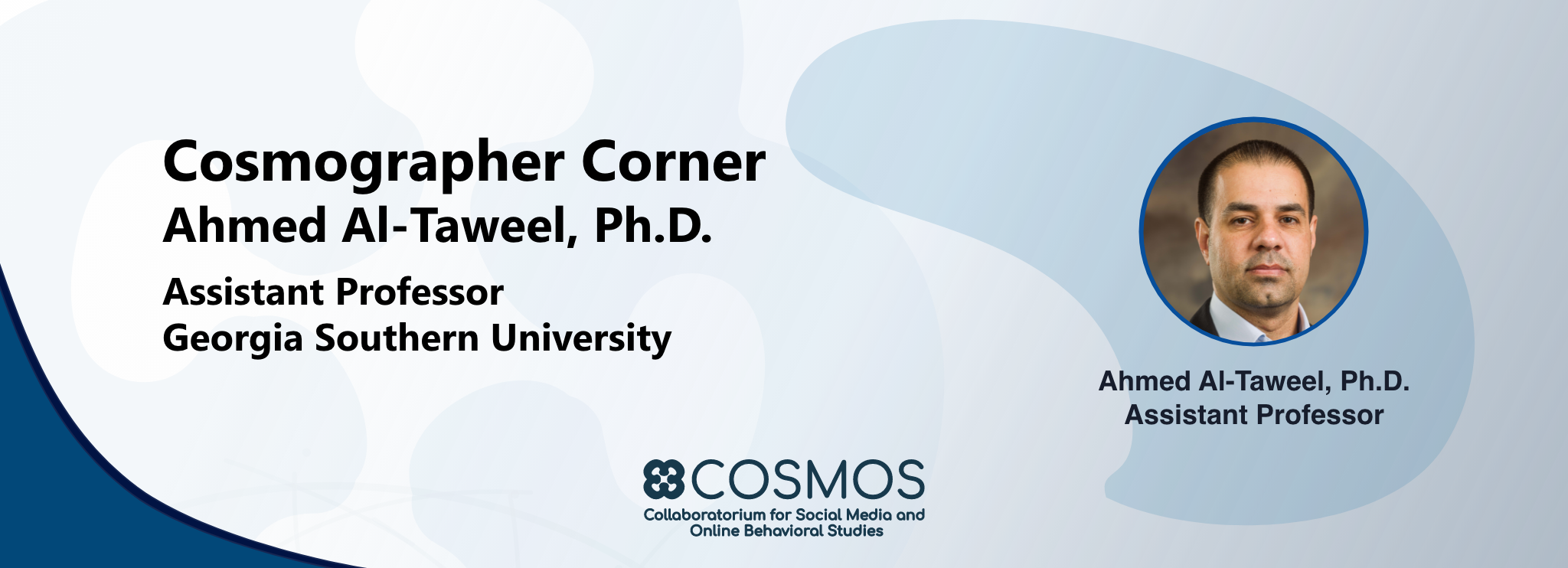
How did you come across COSMOS?
During the final semesters of my doctoral studies at UALR, I became familiar with Prof. Agarwal’s research and was impressed by the significant interdisciplinary work he was leading. I joined him and started working at COSMOS as a graduate research assistant on his projects. I was strongly interested in the opportunity to apply mathematical methods to important, real-world problems. When I began searching for a postdoctoral research fellowship position, I reached out to him to express my interest. We had several discussions about how my background in mathematics could support and collaborate with his future research projects. I appreciated his vision and the opportunity to contribute to valuable research projects as a postdoctoral fellow.
What role did COSMOS play in your educational career at UALR?
Prof. Agarwal and COSMOS played a key role in my scholarly development. I initially joined the team as a graduate research assistant while completing my Ph.D., and after earning my doctorate, I continued as a postdoctoral fellow. This experience expanded my perspective on how mathematics can be applied beyond theory. It strengthened my research expertise, exposed me to interdisciplinary collaboration, and provided hands-on experience working with real-world data. Under Prof. Agarwal’s mentorship at COSMOS, I worked on several research projects, including narrative analysis, churn analysis, and epidemiology models using data from social media platforms. These projects enabled me to apply mathematical modeling and computational methods to important, real-world problems. Prof. Agarwal’s research projects at COSMOS helped bridge the gap between theoretical mathematics and applied computational research, developing my skills as an interdisciplinary researcher.
How would you describe the research that you worked on while at COSMOS? In other words, what was the specific area in which you researched?
At COSMOS, Prof. Agarwal introduced me to two research projects on narrative analysis and churn analysis. The first project focused on narrative analysis, examining how narratives spread and evolve on social media platforms. We examined whether narratives behave like contagious processes and developed mathematical and computational models to track narrative diffusion over time. The goal was to better understand how ideas, information, and opinions propagate through online communities. In the second project on churn analysis in social networks, we developed predictive tools to understand why users disengage or leave online platforms. By analyzing user behavior patterns, we aimed to identify factors that influence participation, retention, and long-term engagement. Together, these two projects combined statistics, data science, and mathematical modeling to better understand socio-technical behaviors in digital environments.
How did COSMOS shape your career path or personal growth?
Prof. Agarwal had a strong impact on both my professional direction and personal progress. His mentorship strengthened my ability to manage multiple research projects, collaborate across disciplines, and supervise students engaged in research. Most importantly, he helped me reimagine my view of mathematics. He showed me how to connect theory with real-world applications, making mathematics more dynamic, relevant, and powerful in my scholarly work. This experience influenced how I design courses, mentor students, and structure research projects in my current role.
Since leaving COSMOS, what roles/positions/jobs have you had? What is your current work?
After leaving COSMOS, I joined Georgia Southern University as an Assistant Professor in the Department of Mathematical Sciences. I teach undergraduate and graduate courses. In many of my upper-level classes, I incorporate project-based learning. I encourage students to start early, set clear milestones, and collaborate to complete meaningful research-driven projects. I have also taught a Research Methods course and developed a new course, Advanced Data Science, where I integrate the modeling techniques and interdisciplinary perspective I learned while working with Prof. Agarwal at COSMOS. Additionally, Prof. Agarwal’s mentorship during my postdoctoral fellowship at COSMOS strengthened my ability to supervise students and coordinate research efforts. This has played an essential role in developing my research program at Georgia Southern University, where I continue to work at the intersection of mathematics, data science, and real-world applications.
Please share some memories from your time at COSMOS.
One of the most defining experiences of my time at COSMOS was working as a Postdoctoral Research Fellow under the mentorship of Prof. Agarwal. His leadership and guidance played a key role in my professional development. He consistently challenged me to evaluate critically, supported my growth as an independent researcher, and reinforced my ability to undertake complex, impactful research projects. While at COSMOS, I was exposed to opportunities that broadened my career perspective, including pathways in both academia and industry. Through collaborative data analysis and interdisciplinary research projects, I gained an enhanced appreciation for applying mathematical and computational methods to important, real-world problems. The weekly Friday research meetings were notably influential. They provided a structured environment for intensive discussion, idea development, and careful refinement of our research both before and after publication. These sessions strengthened my analytical thinking, academic communication, and collaborative skills. Overall, my experience at COSMOS strongly influenced my scholarly identity and enhanced my appreciation for interdisciplinary collaboration, academic interest, and sustained research engagement.
What advice would you have for current Cosmographers?
When I first joined COSMOS, it was challenging as it was a new environment, new research problems, new discipline, etc. However, with Prof. Agarwal’s consistent support and understanding, things improved and became successful. His advice to me was that every difficult beginning can become a great opportunity if you do not give up. My advice to students at COSMOS is simple: listen to Prof Agarwal and keep going. Prof. Agarwal has created an amazing environment at COSMOS – one that has world-class technical infrastructure, highly supportive teams, real-world research opportunities, and a terrific support system. Do not waste your time. Use each opportunity to learn and work on different projects. Try to join as many projects as you can. Each project builds your experience and shapes your skillset. Grab these opportunities. Rewards and achievements will come sooner than you think. Do not be afraid to take on new tasks or learn new skills. Step outside your comfort zone. Growth happens when you challenge yourself. Stay focused on your goals. Even if you do not see results right away, trust that your hard work will pay off. Stay consistent. Stay motivated. Believe in yourself. Publish your work, contribute to the scientific community, and aim high. Most importantly, never give up. The effort you make today will become the success you celebrate tomorrow.