
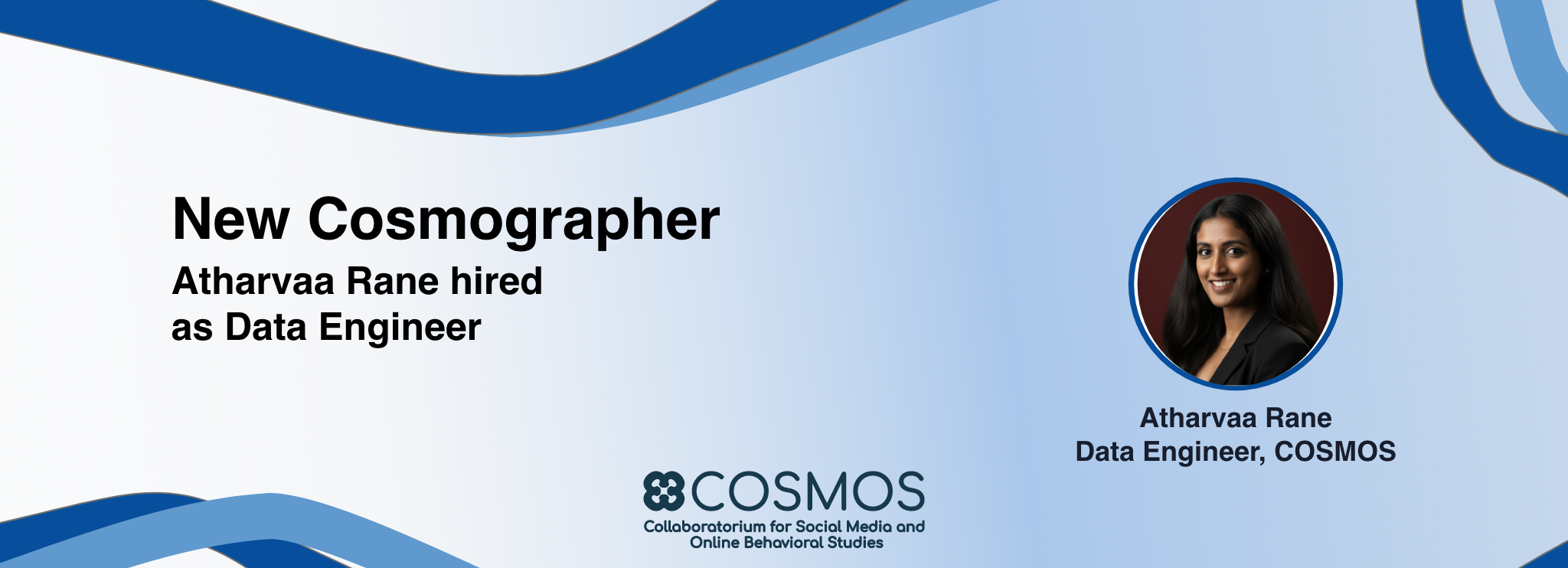
There is a new addition to the COSMOS family! We hired a new full-time Data Engineer, Atharvaa Rane! Atharvaa shares what attracted her to COSMOS, as well as her aspirations and goals.
What is your name, and what role do you play at COSMOS?
My name is Atharvaa Rane, and I work at the COSMOS Research Center as a Data Engineer. I am working on the BlogTracker project, where I help build data pipelines, backend APIs, and AI-driven analytics for blog data. My role involves improving system architecture, enhancing data ingestion and processing workflows, and supporting machine learning–based analysis.
Can you share a bit about your professional background and experience?
I recently completed my Master’s in Computer Science from Syracuse University, where my focus was on machine learning, data engineering, and analytics. Alongside academics, I’ve worked in roles that sit at the intersection of data, engineering, and applied AI. Upon graduation, I worked at iConsult Collaborative as a Data Analyst, building Python and SQL pipelines and Power BI dashboards to automate compliance tracking and improve decision-making for real clients. I’ve also worked as a Data Engineer and AI/ML Developer Intern at ToyzElectronics, where I helped develop personalized recommendation systems and APIs for an ed-tech platform serving over 10,000 users. Across these roles, I’ve enjoyed end-to-end problem solving—from messy data ingestion to building systems that people actually use.
Which aspects of COSMOS culture or mission stood out to you and why?
What stood out most to me about COSMOS is Prof. Agarwal’s strong focus on research with real-world impact. The work led by Prof. Agarwal doesn’t stop at publishing or building models for academic publications — it’s about making it accessible to society at scale. I also value the interdisciplinary and collaborative culture fostered by Prof. Agarwal at COSMOS, where engineers, researchers, and domain experts work closely together. That balance of technical depth, curiosity, and purpose really aligns with how I want to grow as a researcher and engineer.
Are there any specific skills or experiences you’re looking to gain here?
I’m particularly excited to deepen my experience in building large-scale data pipelines and social media analysis, and applied machine learning. I want to sharpen my ability to design systems that are not just technically sound, but also interpretable, ethical, and useful for researchers and stakeholders. I’m also eager to learn more about translating research ideas into robust, production-ready tools.
Did anything during your onboarding experience surprise or stand out to you?
What stood out during onboarding was how welcoming and supportive the environment felt. I appreciated how open everyone was to questions and how clearly expectations and goals were communicated by Prof Agarwal. It made it easier to feel like I could contribute early on rather than just observe from the sidelines.
How do you anticipate your role at COSMOS helping your growth on both a personal and professional level?
Professionally, this role pushes me to think more deeply about data beyond accuracy and performance, to consider context, impact, and responsibility. Working at COSMOS encourages me to be more thoughtful in how I design systems and interpret results. On a personal level, collaborating with researchers from different backgrounds helps me grow as a communicator and teammate, and it’s building my confidence in working on complex, open-ended problems.
From your experience, what tips, insights, or advice would you share with someone starting a new role at COSMOS?
My biggest advice would be to ask questions early and often, and not be afraid to explore ideas outside your immediate task list. At COSMOS, Prof. Agarwal has cultivated an environment that values curiosity, where initiative and active engagement in discussions enhance learning. Also, documenting your work and thinking out loud with teammates goes a long way in collaborative research environments.
If you could share a meal with any historical figure or fictional character, who would it be and what would you want to talk about and want to learn from them?
I’d choose Leonardo da Vinci. I’d want to talk to him about how he connected ideas across art, science, engineering, and human behavior so naturally, without putting them into separate boxes. I’d love to learn how he stayed curious across so many domains and how he approached learning when formal structures or tools didn’t exist the way they do today. That kind of mindset—blending creativity with analytical thinking—feels especially relevant when working on complex, interdisciplinary problems.