
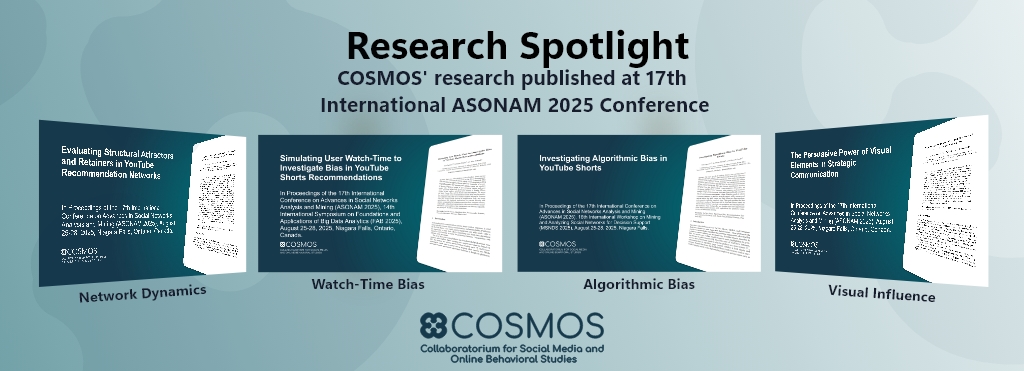
At the 17th International Conference on Advances in Social Networks Analysis and Mining (ASONAM 2025), held in Niagara Falls, Ontario, Canada, from August 25-28, 2025, researchers from COSMOS at the University of Arkansas at Little Rock presented ten studies, from which we spotlight four pioneering studies at the intersection of social networks, algorithmic bias, and strategic communication.
The first study, “The Persuasive Power of Visual Elements in Strategic Communication,” examines how visual features such as color, imagery, and design affect message framing and influence audience perception in digital environments. The research demonstrates the critical role of visual cues in amplifying persuasive impact and shaping engagement dynamics across online platforms.
Another contribution, “Evaluating Structural Attractors and Retainers in YouTube Recommendation Networks,” introduces a novel approach to identifying key network structures that drive user retention and content exposure within YouTube’s recommendation system. The findings reveal how algorithmic designs can unintentionally favor certain content clusters, reinforcing echo chambers and influencing user behavior over time.
The third study, “Investigating Algorithmic Bias in YouTube Shorts,” advances understanding of how short-form video algorithms shape visibility and engagement patterns. By analyzing data from YouTube Shorts, the study uncovers indicators of algorithmic bias that may lead to unequal representation of creators and content types, raising important questions about fairness and transparency in AI-driven media ecosystems.
The fourth paper, “Simulating User Watch-Time to Investigate Bias in YouTube Shorts Recommendations,” presents a simulation-based framework to explore how watch-time metrics influence algorithmic recommendations. The study highlights how user behavior signals can reinforce existing biases and offers insights into designing more equitable and transparent recommendation systems.
Prof. Agarwal said, “Collectively, these studies bridge theoretical, computational, and applied research, integrating methods from social computing, behavioral-cultural modeling, AI/machine learning, and graph theory to investigate societal implications of algorithmic systems and advancing our cognitive security apparatus.
Together, these contributions reaffirm COSMOS’s leadership in advancing interdisciplinary research that deepens understanding of how algorithms, media, and human behavior converge to shape today’s complex information landscape.”