
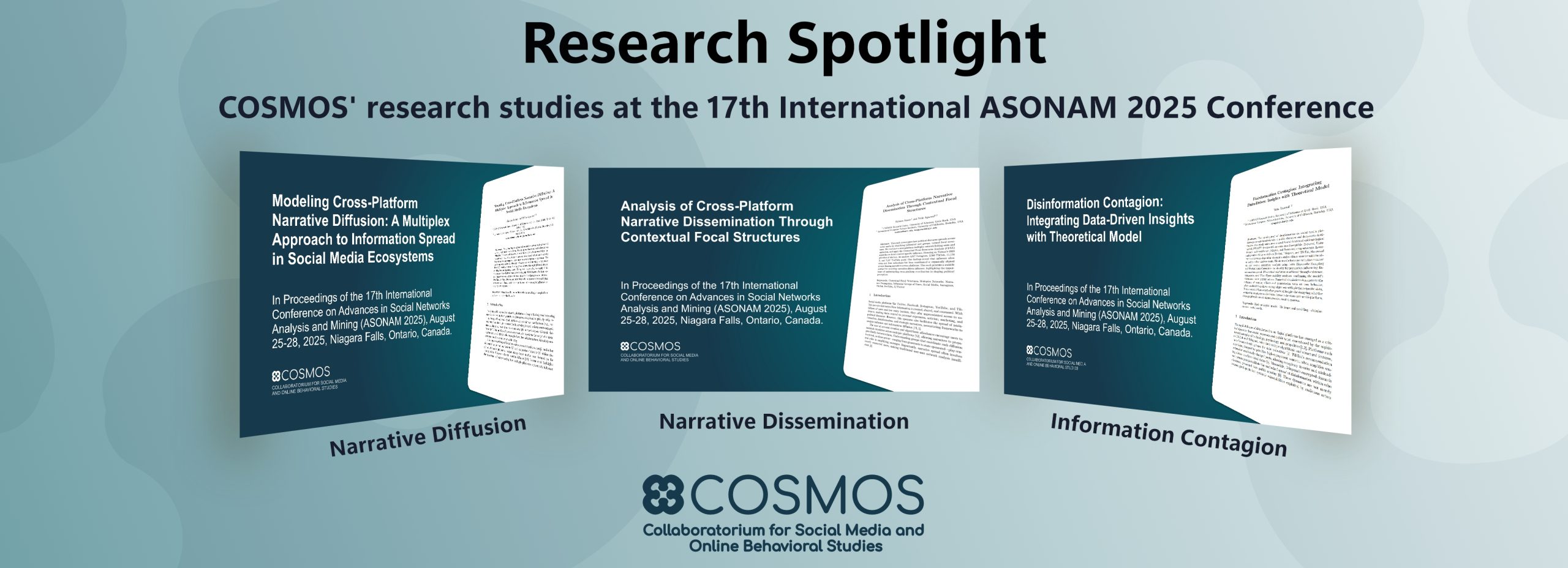
At the 17th International Conference on Advances in Social Networks Analysis and Mining (ASONAM 2025), held August 25-28, 2025, in Niagara Falls, Ontario, Canada, three significant contributions from the COSMOS research team were presented. The conference, dedicated to interdisciplinary work on social network analysis, mining, machine learning, graph theory, and real-world social systems, brought together scholars and practitioners to explore emerging trends in network science and socio-technical systems.
The first study, Information Contagion: Integrating Data-Driven Insights with Theoretical Model, undertakes a dual-pronged approach: they combine empirical data on information spread with theoretical modeling inspired by contagion dynamics in networks. Their work reveals how false narratives can propagate in online communities in patterns analogous to epidemiological contagion, with key nodes and structural vulnerabilities driving rapid spread. This synthesis of data (e.g., social media logs, diffusion traces) with abstraction (mathematical or agent-based models) enables identification of tipping points, resilience thresholds, and intervention opportunities in information ecosystems.
Another study: Modeling Cross-Platform Narrative Diffusion: A Multiplex Approach to Information Spread in Social Media Ecosystems, advances modeling beyond single-platform analyses. The authors adopt a multiplex network framework, i.e., networks composed of multiple types of nodes and edges representing different platforms or media channels to trace how narratives migrate from one platform to another (e.g., from Twitter, Facebook, and Telegram). The findings highlight cross-platform linkage, propagation cascades across platforms, and the importance of inter-platform edges in amplifying reach and speed of narratives.
The third study, Analysis of Cross-Platform Narrative Dissemination Through Contextual Focal Structures. digs deeper into the micro-structure of narrative dissemination. The authors examine how focal structures, context clusters, pivotal nodes, and bridging nodes serve as channels through which narratives anchor themselves and then spread widely. They demonstrate how narrative diffusion is not just about network paths, but about contextual alignment, structural focal points, and timing. Their analysis offers insights into how certain nodes or contexts accelerate spread and how interventions might target these structural focal points to disrupt harmful narrative chains.
In conclusion, these three studies collectively push forward our understanding of how information, narratives, and information campaigns travel not only within a single platform but across interconnected social media ecosystems. They integrate theoretical network models with data-driven insights, leverage multiplex and structural analysis of cross-platform dynamics, and highlight how narrative and information campaigns can be understood, anticipated, and mitigated in the digital age.