
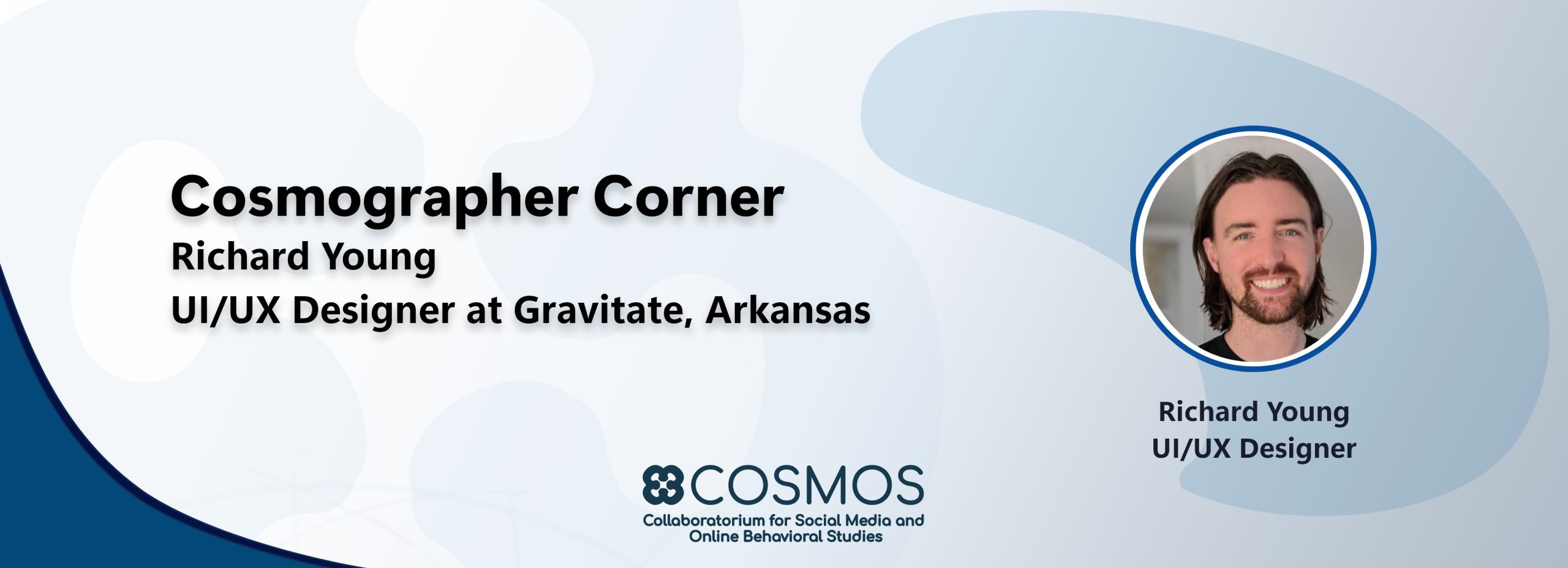
In this edition of Cosmographer Corner, we’re proud to feature Richard Young, a former COSMOS researcher and graduate of the University of Arkansas at Little Rock. Richard earned his Master of Science in Information Science in 2019, having begun his graduate journey in 2017. During his time at UA Little Rock, Richard was an active contributor to COSMOS, working on projects at the intersection of data, design, and social impact.
Today, Richard is a UI/UX Designer at Gravitate, a design company based in Fayetteville, Arkansas. His work continues to reflect the values and skills he developed during his time with COSMOS applying thoughtful design to complex problems in a fast-evolving digital landscape.
“I am proud of the accomplishments and the various contributions Richard has made to the COSMOS Research Center. We all celebrate his academic journey and wish him the best at Gravitate” said Prof. Agarwal.
We caught up with Richard to hear more about his current role, his reflections on COSMOS, and his advice for current and future Cosmographers.
How did COSMOS fit into your university/secondary education career? How did you come across COSMOS, and what were you studying when you joined COSMOS?
During my undergraduate studies at the University of Arkansas at Little Rock (UALR), I majored in e-commerce with a focus on web application development. As an intern with IT Services, I worked on marketing and analytics tracking website traffic and optimizing site performance which gave me an early foundation in both frontend development and data-driven user experience improvement.
After graduation, I joined a smaller company as a frontend developer, further honing my design and coding skills. Around that time, I connected with Prof. Agarwal at COSMOS. He was developing a product called YouTube Trackers. They were seeking someone with both design sensibility and data experience, and that’s how I became involved.
Joining COSMOS was transformative. With Prof. Agarwal’s support, I pursued a Master’s in Information Science through a graduate assistantship at COSMOS that allowed me to balance academics and applied research. This synergy between coursework and project work strengthened the bridge between my academic and professional growth.
At COSMOS, I learned to use data not just to build software, but to create impactful tools and solutions that simplify complex tasks by delivering timely insights. Our work even extended to collaborations with NATO, analyzing blogs and YouTube data. The experience went beyond coding; it was about designing systems that empower informed decision-making and improve workflows.
In the end, COSMOS was more than a job. It was an extension of my education and a catalyst for my evolution as both a developer and designer.
How did COSMOS contribute to your career and program at UALR? What was Prof. Agarwal’s role in your journeys during and after?
COSMOS was a turning point in both my academic and professional journey. While pursuing my master’s in Information Science at UALR, I joined the center as a graduate researcher under the mentorship of Prof. Nitin Agarwal. Coming from a background in frontend development and design, I initially focused on usability and aesthetics. COSMOS challenged me to expand that skill set by applying design principles to complex, data-driven problems with significant real-world implications. This experience became the foundation of my career as a UX designer, where I now work with large, often sensitive datasets and translate them into meaningful, usable insights that balance usability, ethics, and clarity.
What distinguished COSMOS was its emphasis on studying online behavior and influence. We were not simply building tools; we were uncovering how narratives spread, how information campaigns operate, and how digital communities are manipulated. Team discussions about countering trolls or identifying coordinated influence campaigns remain some of the most formative lessons of my career. They continue to shape how I think about trust, design, and the dynamics of online communities.
Prof. Agarwal’s mentorship was instrumental in developing my critical perspective on information systems and their societal impact. He introduced us to emerging technologies such as generative AI well before they became mainstream, warning us about their potential to amplify influence campaigns. One project that left a lasting impression involved analyzing fake blogs tied to a fabricated immigration event. Despite knowing it was false, repeated exposure still influenced my perception demonstrating the subtle but profound impact of online narratives.
Ultimately, COSMOS gave me more than technical expertise. It instilled in me a mindset of responsibility and purpose in designing technology, and Prof. Agarwal’s guidance was central to that transformation.
How would you describe the “research pipeline” that you worked on while at COSMOS? In other words, what was the specific area in which you researched.
During my Master’s in Information Science, I approached my research at COSMOS from a non-traditional perspective. With a background in UI/UX, product design, and community innovation through local innovation centers and startup weekends, I initially focused on building user-centered products that emphasized how people interact with technology.
As I became more involved, I collaborated across teams and contributed to diverse research efforts, particularly in data visualization and storytelling for academic work. One area that stood out and ultimately inspired my capstone was the connection between visual design, emotion, and media analysis. I was intrigued by the concept of “movie barcodes,” where each frame of a film is compressed into a strip to visually summarize its emotional arc. Learning how studios like Pixar use color theory to shape emotional beats made me wonder: could similar patterns in online videos reveal strategies of emotional manipulation.
This idea became the foundation of my capstone project, where I built a prototype tool to generate movie barcodes from YouTube videos. The tool enabled researchers to compare videos visually over time, revealing potential patterns of copying or manipulation. Later, I co-authored a research paper expanding the work with machine learning, blending my UX-driven perspective with technical analysis. COSMOS gave me the space to merge creative design, human-centered research, and emerging technologies.
Since leaving COSMOS, what roles/positions/jobs have you had? What is your current work? What positions did COSMOS and your classes at UALR best prepare you for?
Since leaving COSMOS, I have built my career as a UX Designer, applying the data-driven and human-centered mindset I developed during graduate school. My first role was at 1st Orion, a telecommunications company in Little Rock, where I worked on spam and scam call protection. The mission felt closely connected to my COSMOS experience addressing real-world threats from bad actors and protecting people through thoughtful design and data.
I then joined a design agency specializing in enterprise data challenges. There, I worked with large, complex datasets to create intuitive interfaces that turned information into actionable insights. The fast-paced environment allowed me to refine and expand the skills I had honed in research, visualization, and user-focused design.
Currently, I am a UX Designer at Gravitate, a Fayetteville-based company where I continue to design solutions that simplify complexity and help users make informed, timely decisions.
The foundation I built at COSMOS particularly through courses in data visualization, game design, and social computing remains central to my approach. I learned how to cut through noise, clarify complex insights, and design responsibly. In today’s AI-driven landscape, those lessons are even more relevant as designers must balance innovation with ethics, responsibility, and human impact.
If you had to describe the most momentous event at COSMOS, what would it be? (Such as a specific conference you presented at, or a specific paper presented, or a project you worked on.)
One of the most defining experiences of my time at COSMOS was earning my master’s degree in Information Science. Becoming the most formally educated person in my family was deeply meaningful, and Prof. Agarwal at COSMOS was central to that achievement, challenging me, supporting me, and proving that I could take on complex, impactful work. COSMOS also revealed opportunities I hadn’t considered, including the possibility of pursuing a Ph.D., which became apparent during projects like the movie barcode research. That project, which compressed massive video files into single comparative images, gave me a glimpse into the innovative and advanced work we were contributing to.
COSMOS also shaped my personal growth. During that time, I discovered I have dyslexia and ADHD, which helped me better understand my learning style, communication, and strengths particularly my ability to connect ideas across domains. This perspective enriched my UX work and deepened my empathy for diverse user experiences.
Most importantly, Prof. Agarwal gave me a broader understanding of how media, algorithms, and metadata influence beliefs and behaviors. That awareness continues to guide me in UX, reminding me to design responsibly, consider ethical implications, and always see the bigger picture in our rapidly evolving digital world.
What advice would you have for current Cosmographers? (Such as looking for conferences to present at, jobs to apply for, and recommending fields that social computing research/skills can be applied to.)
This is an especially exciting and critical time to be part of COSMOS. The challenges we studied AI-generated content, information campaigns, and media manipulation have only intensified. What once took malicious actors hours or days can now be done in minutes with AI. Fake websites, spoofed media, and manipulated narratives are everywhere, making COSMOS’s research and tools more relevant than ever. If you’re passionate about helping people cut through noise, protect themselves, and make better decisions, this is the moment to dive in.
My advice is to keep people at the center of your work. The scale of the information campaign can feel overwhelming, but focusing on real human needs makes the impact meaningful. Projects like YouTube Tracker inspired me not only for the technology but because they gave creators valuable insights to grow. Don’t be discouraged if you’re not a programmer. I wasn’t either when I started. I taught myself Python and OpenCV to build early prototypes, and today AI and low-code tools make experimentation even easier.
Finally, share your work early and often. Conferences gave me feedback, clarity, and a professional network that opened doors. Collaboration across disciplines and diverse perspectives lead to stronger, more impactful solutions. Working with Prof. Agarwal means entering a space where vision turns into possibility. His leadership is not only guiding but also empowering, challenging you to uncover strengths you never realized you had. At COSMOS, you become part of something greater than yourself—a mission where every effort creates lasting impact. This is more than an opportunity; it’s a calling. Step into it, and make your mark.