
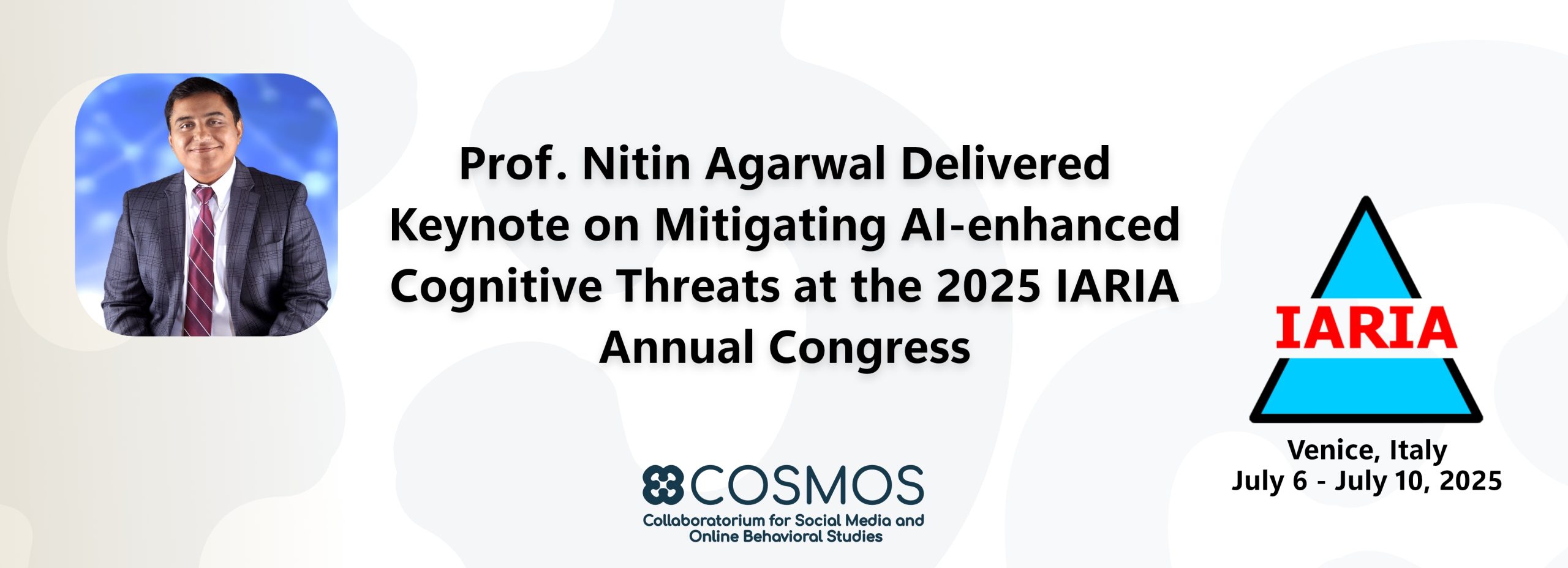
At the 2025 IARIA Annual Congress on Frontiers in Science, Technology, Services, and Applications, held in Venice, Italy, Prof. Agarwal’s keynote delved into a critical frontier in contemporary AI research: the emergence of AI-driven cognitive threats and the parallel need to develop AI-powered methodologies to neutralize them. As artificial intelligence continues to transform how information is created, shared, and perceived, it has also opened new avenues for malicious actors to manipulate digital environments in ways that can distort reality, influence public sentiment, and undermine trust in digital systems.
The keynote emphasized that traditional approaches to monitoring and mitigating cognitive threats are no longer sufficient in the face of sophisticated AI-generated content and coordinated influence tactics. Instead, there is a pressing need for innovative, adaptive, and intelligent countermeasures that can operate at scale and speed.
In response, the presentation introduced a comprehensive framework of socio-computational methodologies that leverage advanced AI capabilities. These methodologies are designed to detect emerging cognitive threats in real time, analyze large-scale behavioral and interactional patterns across platforms, and provide actionable insights for timely intervention. Key components of the framework include AI-based content analysis engines that scan digital ecosystems for anomalies, network mapping tools that visualize clusters of influence and behavioral convergence, and predictive models that simulate how specific narratives or ideas may evolve and impact communities over time.
A unique aspect of the approach is its capacity to generate responsive strategies—such as narrative countering or audience-specific content interventions—that aim to reestablish informational balance and strengthen cognitive resilience. These interventions are not reactive but strategically designed to minimize potential harm, support informed engagement, and reinforce critical thinking in digital interactions.
The keynote framed this paradigm as “fighting fire with fire”—advocating for the use of AI not only as a tool for advancement but also as a line of defense against its own adversarial uses. It highlighted the importance of interdisciplinary collaboration across academia, industry, and policy domains to ensure the ethical design, deployment, and governance of such systems. Ultimately, the presentation underscored that safeguarding the cognitive domain in the age of AI requires both technological innovation and a shared commitment to preserving the integrity of digital discourse.