
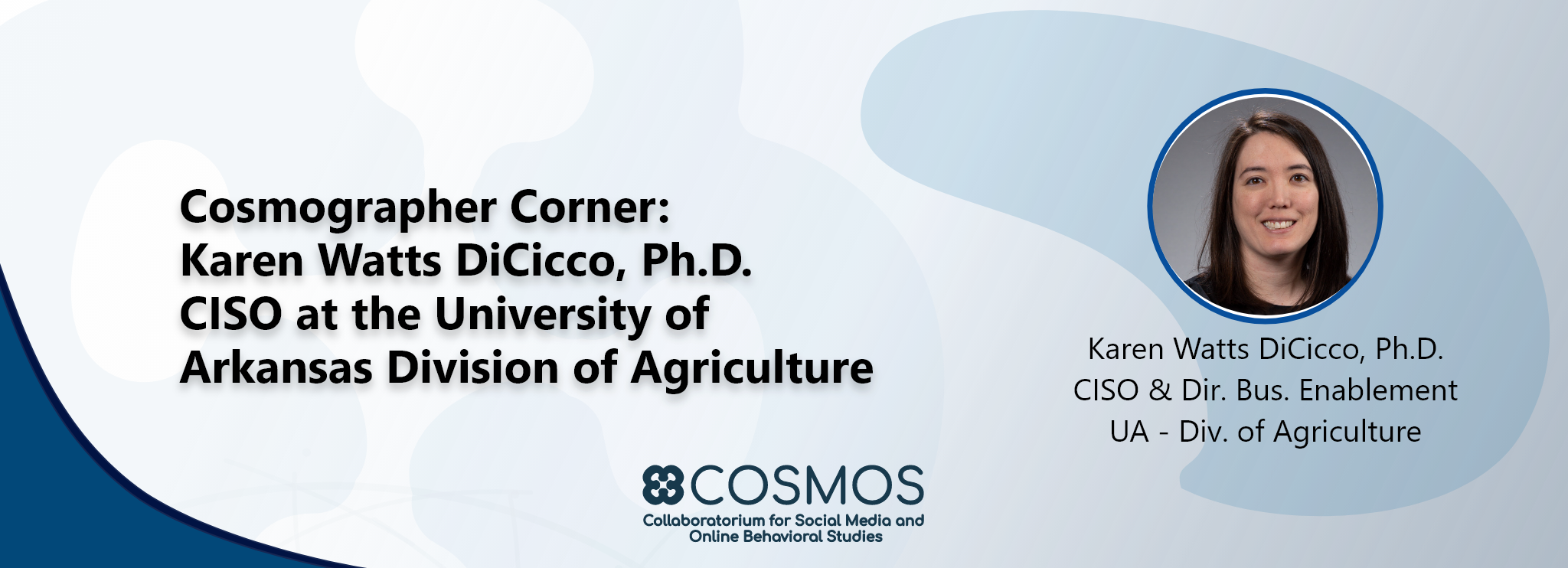
In this edition of Cosmographer Corner, we highlight the work of a former UA Little Rock graduate and cosmographer, Karen Watts DiCicco. We are incredibly proud of Karen’s accomplishments!
Karen, the Chief Information Security Officer and Director of Business Enablement and Enterprise Applications at the University of Arkansas System Division of Agriculture, began her graduate studies in Information Science at UA Little Rock in 2019 and earned her Ph.D. in 2022 – both under Prof. Agarwal’s supervision at COSMOS.
Following her graduation, Karen took on the role of Assistant Director of Information Technology, steadily advancing to her current leadership position within the University of Arkansas System Cooperative Extension Service. During her time as a graduate student, she also worked at COSMOS as a graduate research assistant under Prof. Agarwal’s supervision.
We had the opportunity to speak with Karen about her professional journey and her experiences at COSMOS—her insights are shared below.
How did COSMOS fit into your university/secondary education career? How did you come across COSMOS, and what were you studying when you joined COSMOS?
I first became involved with COSMOS in the fall of 2017 while pursuing my bachelor’s degree in Information Science. At the time, I had a strong interest in higher education and research. Although my career path was not yet clearly defined, I knew I wanted to be part of something meaningful and collaborative. Having heard about Prof. Agarwal and the groundbreaking work at COSMOS, I decided to reach out—and was fortunate to join the team that same semester.
From the beginning, I was actively engaged in a variety of projects, including blog trackers, V-trackers, technical documentation, and tutorial videos. These efforts not only enhanced my skill set but also aligned closely with what I was learning in my coursework. The experience I gained at COSMOS directly contributed to my professional growth and eventually led to a position at the University of Arkansas Division of Agriculture, where I initially focused on virtul education, collaborating with the Southwest ADA Center. That role reflected many aspects of my work at COSMOS and later transitioned into a more development-oriented position.
Throughout my academic journey—from bachelor’s to master’s to Ph.D.—my connection with COSMOS remained strong. It was far more than a research group; it became a vital part of both my academic and professional development. I even incorporated COSMOS into my research, making the experience even more enriching. In every sense, COSMOS served as both a foundation and a launching point for my career in information science and development.
How did COSMOS contribute to your career and program at UALR? What was Prof. Agarwal’s role in your journeys during and after?
COSMOS has been instrumental in shaping both my academic journey and professional career at UA Little Rock. One of the most impactful skills I gained during my time there was the ability to translate complex, high-tech solutions into practical tools and clear language that non-technical users can easily understand and apply. This skill has proven invaluable in my current role and continues to influence how I approach technology integration and training.
Throughout both of my graduate programs, I had the privilege of learning from and working with Prof. Nitin Agarwal, who not only served as my professor but also as a mentor. His guidance was essential to my development as a researcher and a professional. My work with him at COSMOS ranged from technical documentation and training materials to software development—experiences that directly translated to my current responsibilities.
Interestingly, I hadn’t anticipated a career in agriculture, but my role at the University of Arkansas System Division of Agriculture has revealed just how diverse and impactful the field is. It extends far beyond traditional farming. While we conduct research in crops like rice, corn, and soybeans—Arkansas being a leading rice producer in the U.S.—we are also involved in cutting-edge areas such as bioengineering, drone-based precision agriculture, image recognition, youth development through 4-H, small business support, and public health education.
In my current role, I focus on technology and security, overseeing business enablement, enterprise applications, application development, and cybersecurity. I lead teams responsible for software procurement, employee training, custom web application development, online forms, video conferencing, and information security. Much of the foundation for this work was built at COSMOS, particularly in learning how to make technology both accessible and scalable.
How would you describe the “research pipeline” that you worked on while at COSMOS?
At COSMOS, my research primarily centered on two key areas: software usability and the study of information campaigns on social media platforms. I was deeply involved in the development and evaluation of two flagship tools created by COSMOS—V(ideo)Tracker and BlogTracker. My role encompassed comprehensive feature testing, bug tracking, usability assessments, and the creation of tutorial videos and instructional materials aimed at making these tools more accessible to non-technical audiences.
On the research front, my focus was on online toxicity and cross-platform analysis. I explored the prevalence of toxic behavior across various social media platforms within the broader context. This work contributed valuable insights into how different platforms manage harmful content and which environments are more prone to fostering toxic interactions.
Since leaving COSMOS, what roles/positions/jobs have you had? What is your current work? What positions did COSMOS and your classes at UALR best prepare you for?
Since my time at COSMOS, I have continued to advance professionally within the University of Arkansas System Division of Agriculture, where I have now been for over eight years. After completing my bachelor’s and doctoral degrees, I transitioned into the role of Digital and IT Innovation Manager. I was later promoted to Assistant Director of Information Technology and currently serve as the Chief Information Security Officer and Director of Business Enablement and Enterprise Applications.
Both COSMOS and my academic training at UA Little Rock laid a strong foundation for these roles. The hands-on experience I gained at COSMOS—in project management, user-centered technology development, technical training, and stakeholder communication—has been directly applicable to my current work. Whether I’m shaping IT strategy, overseeing enterprise systems, or translating complex cognitive security concepts for non-technical audiences, the skills I developed at COSMOS continue to play a vital role in guiding my professional efforts.
If you had to describe the most momentous event at COSMOS, what would it be? (Such as a specific conference you presented at, or a specific paper presented, or a project you worked on.)
One of the most memorable aspects of my time at COSMOS was contributing to a number of impactful research projects and witnessing our work reach broader audiences—even if I wasn’t the one presenting at conferences. While I didn’t travel to attend those events, I was actively involved behind the scenes. The lab frequently welcomed visits from state officials and university leaders, and I had the opportunity to demonstrate some of the tools we were developing, which was both exciting and rewarding.
During my master’s program, I co-authored my first research paper on blockchain with Prof. Agarwal—an important milestone that opened the door to additional publications during my Ph.D. Some of the most meaningful work I contributed to focused on online toxicity and information campaigns, particularly in the context of vaccine discourse and COVID-19. For my dissertation, I analyzed toxic content across platforms like Twitter and Parler, exploring how these environments differed in terms of harmful behavior.
One especially significant project was the COVID-19 information campaign Tracking Website, which we developed during the pandemic. Being part of an initiative with such real-world impact and social relevance was incredibly fulfilling.
In parallel, my coursework at UA Little Rock equipped me with a strong foundation in project management, stakeholder communication, and technical documentation—all of which continue to be essential in my current role. I frequently translate complex cognitive security concepts into language that is accessible to non-technical stakeholders, a skill I first developed at COSMOS, where bridging the gap between technical innovation and public understanding was a core part of our work.
What advice would you have for current Cosmographers? (Such as looking for conferences to present at, jobs to apply for, and recommending fields that social computing research/skills can be applied to.)
My advice is straightforward: don’t give up. If your paper isn’t accepted on the first try, take the reviewers’ feedback seriously and use it to improve your work. I’ve had papers rejected as well, but through thoughtful revision and persistence, those same papers were eventually accepted. You never truly know what you’re capable of achieving unless you continue to put yourself out there.
The same principle applies to your career. The role I hold today is the result of taking one step at a time, remaining open to new opportunities, and continually learning. What made a significant difference for me was identifying a research area I was genuinely passionate about. My deep interest in emerging technologies kept me motivated and eager to grow.
At COSMOS, I was fortunate to gain exposure to a wide variety of work, from software testing and technical training to social media analysis. These experiences helped me discover where my interests and strengths intersected, ultimately shaping the trajectory of my career.
As technology continues to evolve rapidly, the kind of research conducted at COSMOS is more relevant than ever. Whether addressing information campaigns, enhancing digital tools, or making complex systems more accessible, the work being done is impactful and meaningful. Being part of it was an incredibly valuable experience. I believe the skills, insights, and connections I gained at COSMOS will continue to shape how I approach both research and real-world challenges.
To work with Prof. Agarwal is to step into an environment where vision meets possibility. His leadership doesn’t just guide, it empowers, pushing you to discover strengths you didn’t know you had. At COSMOS, you’re part of a mission larger than yourself, a place where your efforts ripple into real impact. This isn’t just an opportunity, it’s a calling. Rise to it, and leave your mark.