
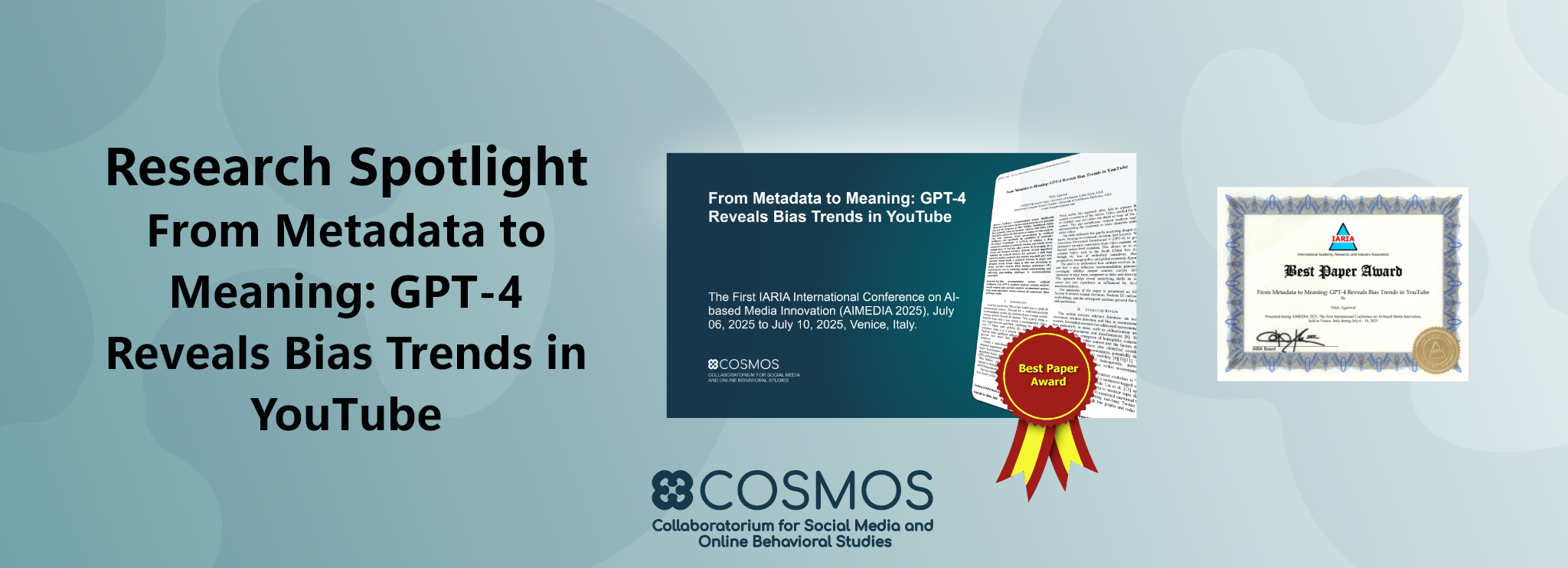
This month, we spotlight pioneering research from COSMOS that explores how artificial intelligence can uncover nuanced patterns of bias within YouTube’s content landscape. Recently presented at the First (IARIA Congress 2025 Program) International Conference on AI-based Media Innovation (AIMEDIA 2025) in Venice, Italy, the study—led by Prof. Nitin Agarwal—received the Best Paper Award for its innovative application of GPT-4 in analyzing the multi-layered structure of digital video content. The research addresses a critical gap in online content analysis: traditional methods often rely on surface-level metadata such as titles or engagement metrics, which may not accurately reflect the underlying emotional and narrative context of the videos. To overcome this limitation, the team applied GPT-4’s advanced language modeling to conduct a multi-level analysis of YouTube videos, examining titles, descriptions, transcripts, and AI-generated summaries.
Through this layered approach, the study revealed that sentiment becomes increasingly positive and joyful as one moves from superficial elements to deeper narrative content. Conversely, expressions of anger decline consistently across content layers, indicating a tonal shift from the more provocative language often used in titles to a calmer and more constructive tone within the video itself. The analysis also found that toxicity was most prominent in titles—likely influenced by engagement-driven strategies—but significantly diminished in the deeper content, suggesting a disconnect between what is presented at first glance and the actual substance of the message.
These findings highlight the importance of evaluating digital content holistically, beyond headline-level impressions. By exposing discrepancies between the framing and the full narrative, the study underscores how engagement-optimized elements may skew perception and influence user interpretation. Prof. Agarwal remarked, “This research showcases how AI can be used to interpret not just data, but meaning—helping us better assess content quality, narrative tone, and underlying patterns that influence user perception.” He emphasized the broader applicability of this approach for developers, researchers, and platform designers seeking greater transparency and context-awareness in digital ecosystems. Ultimately, the study demonstrates the transformative potential of generative AI in enabling more comprehensive, narrative-focused content evaluation and lays the groundwork for future work in algorithmic transparency and digital media analysis.
Click here to read the full article.