
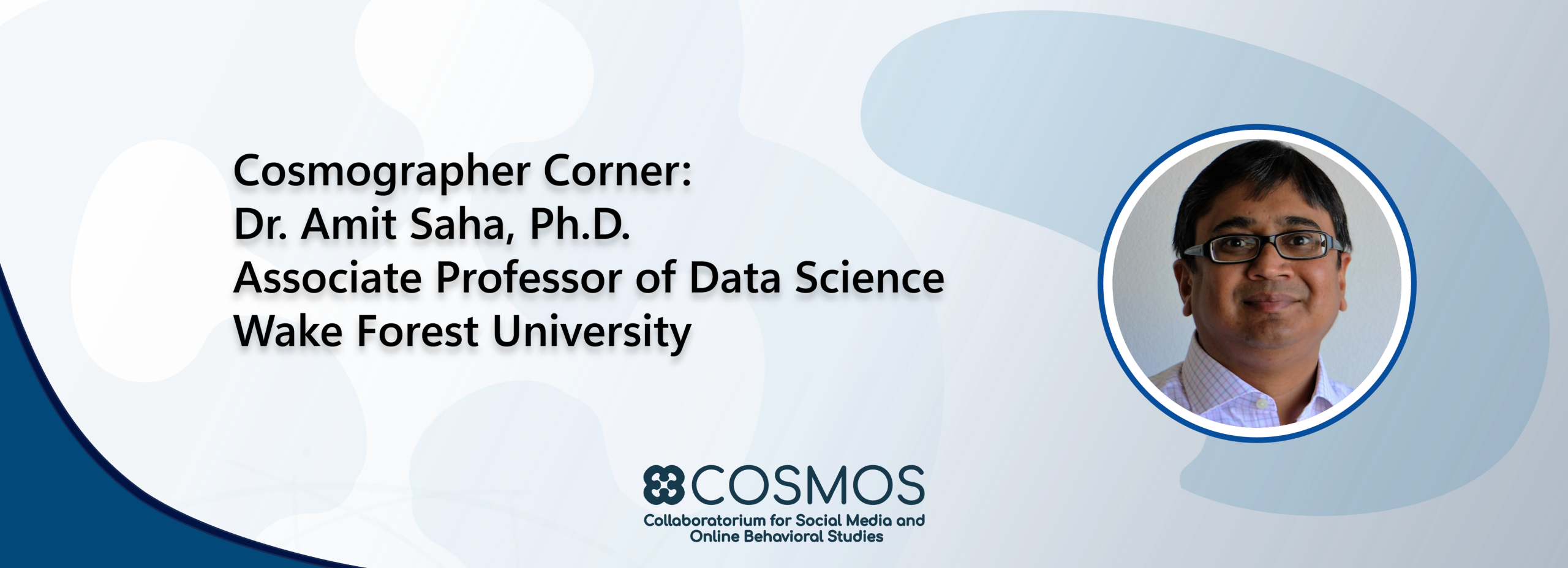
In this edition of Cosmographer Corner, we highlight the work of former University of Arkansas at Little Rock graduate and cosmographer Dr. Amit Saha. We are extremely proud of Dr. Saha’s accomplishments!
Dr. Saha—who is now an associate professor and clinical data scientist at Wake Forest University School of Medicine, teaching systems engineering and data analytics—started his graduate education at UA Little Rock in 2009, studying first for a master’s in Information Quality, and then went on to study and receive in 2016 a PhD in Integrated Computing. We interviewed Dr. Saha on where his career is now and what his work at COSMOS entailed, with his responses below.
How did you find COSMOS?
I first encountered COSMOS while pursuing my master’s degree in Information Quality. Prof. Agarwal was teaching a course on social media analytics, which was part of our curriculum. His work, especially on social media and social network analysis, was fascinating and drew me into COSMOS. At the time, platforms like MySpace were just emerging, so social media was a growing field, and COSMOS provided a compelling opportunity to explore it further. Although I wasn’t involved in the Department of Defense grants Prof. Agarwal had secured, I collaborated with him on healthcare-related projects and co-authored several well-received publications. Later, I continued with the PhD program in Integrated Computing, with COSMOS playing a central role in my academic development.
What role did Prof. Agarwal’s mentorship play in your journey?
COSMOS and Prof. Agarwal were integral to my academic and professional journey. During my PhD, Prof. Agarwal mentored me throughout the entire four-year process, guiding me on how to define research goals, craft research proposals, and stay focused. One of our papers on autism and social media won a Best Paper Award at an international conference, which helped significantly in gaining visibility and eventually securing a faculty position. After graduating, I continued to collaborate with Prof. Agarwal for several years, particularly on healthcare analytics projects. He also advised me on grant writing and remains a mentor to this day—I still reach out to him for guidance.
What did you work on with COSMOS?
At COSMOS, our research primarily centered on the autism community and how individuals with autism engage on social media platforms. Many people with disabilities face challenges expressing themselves online, so we examined how social support—or lack thereof—impacts them. Our goal was to measure whether social media interactions helped reduce stress or provided meaningful support. To do this, we developed a novel algorithm to quantify social support within online communities using text-based data. This resulted in a scoring system—something like a 1-to-10 scale—based on social interaction patterns.
Currently, my research focuses on postoperative care in clinical settings, especially how patients are cared for in the ICU and during anesthesia delivery. I’m working on ways to improve outcomes in the critical care environment. I also teach first-year medical students foundational data science and statistical methods, while advising other researchers on biostatistical approaches.
What positions have you had since graduating?
After completing my PhD, I joined the Wake Forest School of Medicine as an Assistant Professor in the Department of Anesthesiology. I now serve as an Associate Professor and work primarily as a clinical data scientist and biostatistician. I teach data science and statistics to medical students and contribute to various research initiatives. During my PhD, I also worked as a data scientist focusing on care delivery models for high-risk patients. My role today blends teaching, research, and clinical data analysis to help optimize patient care.
What was the momentous event for you while you were at COSMOS?
One of the most momentous experiences at COSMOS was presenting my PhD research at several major conferences. The feedback we received was very encouraging, and our work gained strong recognition. We also published our findings and even authored a book based on the research. These experiences, especially presenting at SBP-BRiMS, were defining moments in my academic journey. The exposure helped establish credibility for our work and propelled my career forward.
What advice do you have for fellow cosmographers?
My advice to current students is to stay open-minded and explore the vast potential of social media analytics. Prof. Agarwal is an exceptional mentor, and the data available in this field is abundant. Unlike traditional “wet lab” sciences, social media research isn’t bound by rigid protocols, allowing for broader application in fields like healthcare and education. Students shouldn’t be afraid to explore outside their comfort zone and should embrace the flexibility and interdisciplinary nature of the work. Keep your eyes open, be curious, and don’t be afraid to take on complex challenges.