
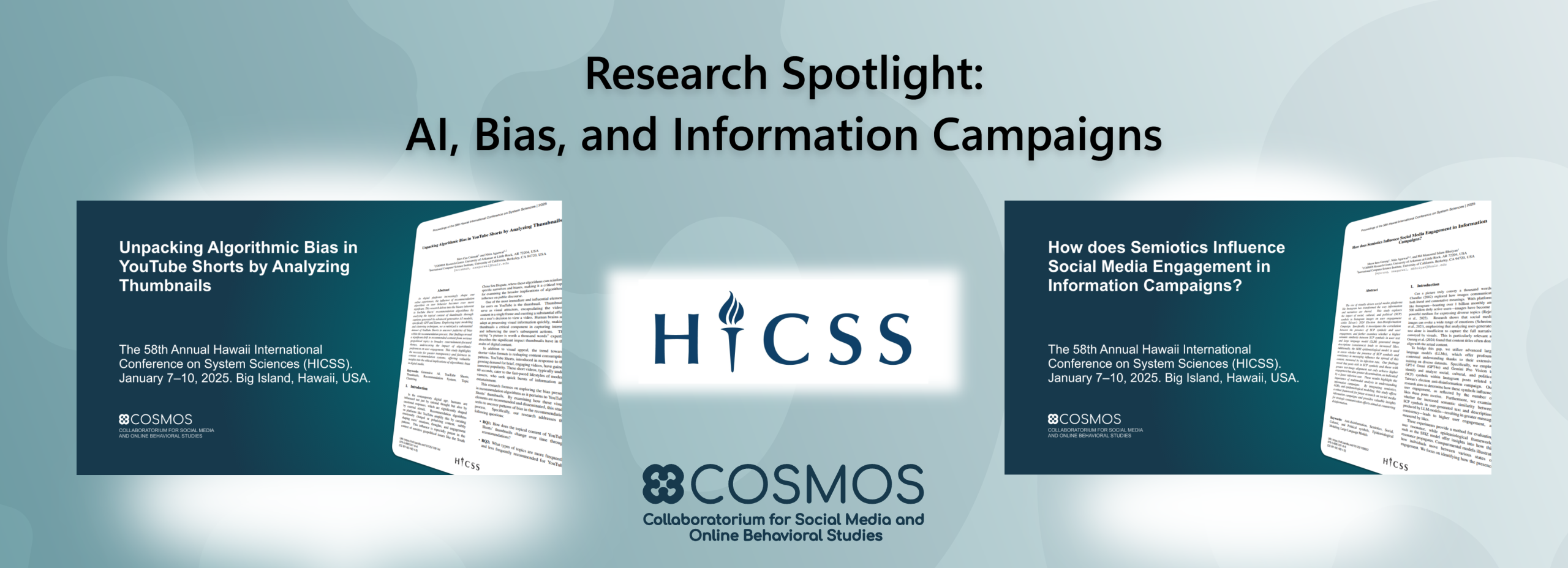
In this month’s research spotlight, we highlight recent research from COSMOS that focuses on using AI to make sense of the multimedia data. These studies were published and presented recently at the 2025 Hawaii International Conference on System Sciences (HICSS) conference, which took place from January 7 to 10, 2025, at Big Island, Hawaii. Specifically, the studies we spotlight here are titled,
- “Unpacking Algorithmic Bias in YouTube Shorts by Analyzing Thumbnails” and
- “How does Semiotics Influence Social Media Engagement in Information Campaigns?”
Each of these studies used AI to make sense of and understand data, allowing the scalability of methods usually limited by manpower. The former used AI to generate captions for YouTube Shorts and analyzed the bias in its recommendation algorithm, while the latter used AI to examine the impact of various types of symbols in multimedia information campaigns.
“Unpacking Algorithmic Bias in YouTube Shorts by Analyzing Thumbnails” examined algorithmic bias in YouTube Shorts by analyzing thumbnail content using AI-generated captions. The researchers studied how recommendation patterns shift as users navigate deeper into the platform’s suggestions, starting with videos about the South China Sea Dispute. They found that regardless of the initial serious geopolitical topic, YouTube’s algorithm quickly shifts recommendations away from the topic. Using topic modeling and clustering techniques (GPT, Llama, and BERTopic), they demonstrated that within a couple of recommendation cycles, the content drifts significantly from news and politics to entertainment, revealing a strong bias.
“How does Semiotics Influence Social Media Engagement in Information Campaigns?” explored how social, cultural, and political symbols in images influenced engagement on Instagram. Using AI models for computer vision to analyze 3,097 images, the study found that posts with more symbols received significantly higher engagement. Additionally, greater coherence between user-generated captions and images led to better engagement. Epidemiological modeling further showed that posts rich in symbols and with high text-image coherence spread faster. This highlights the importance of multimodal analysis in understanding information campaigns.