
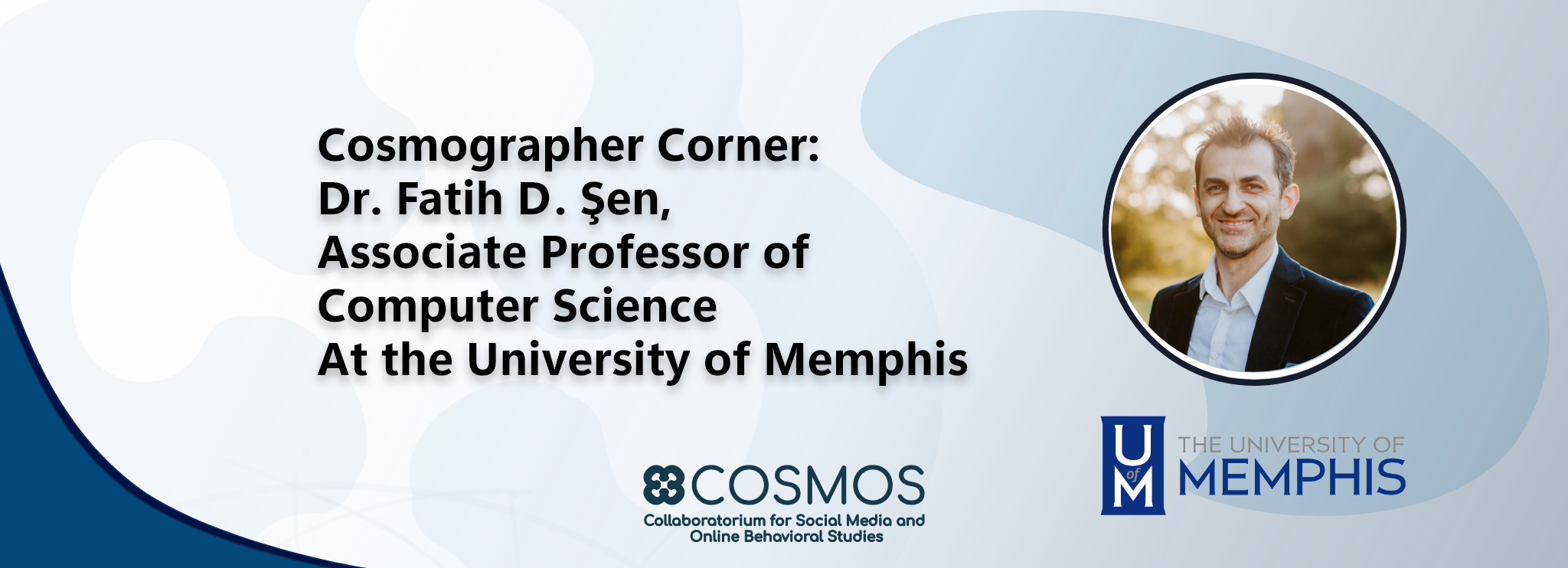
In this edition of Cosmographer Corner, we highlight the work of former University of Arkansas at Little Rock graduate and cosmographer Dr. Fatih D. Şen. We are extremely proud of Dr. Şen’s accomplishments!
Dr. Şen—who is now an associate professor in the department of computer science at the University of Memphis—started his graduate education at UA Little Rock in 2009, studying for a PhD in integrated computing and computer science. In his second year, Dr. Şen joined COSMOS, and then went on to receive his PhD in 2014. We interviewed Dr. Şen on where his career is now and what his work at COSMOS entailed, with his responses below.
How did COSMOS fit into your university/secondary education career? How did you come across COSMOS?
I was really lucky because Prof. Agarwal had just started at UA Little Rock at the time. I was very interested in social networking research—I had even built a network platform with my brother, though it didn’t work out the way we wanted. I wanted to continue with social network research, and when I heard about Prof. Agarwal, I decided to take one of his courses on social computing. That was my first interaction with him. After taking his course, I began working with him on research studies. Prof. Agarwal had just received his first major grant ($750,000) from the U.S. National Science Foundation’s (NSF) Socio-computational Systems program on studying online collective action. I was fortunate to work with him early on. He became one of my advisors, alongside Prof. Rolf Wigand. The collaboration between Prof. Agarwal, Prof. Wigand, and myself really felt like a team effort, and that’s how my journey with COSMOS began—although back then, COSMOS wasn’t formally established.
How would you describe the “research pipeline” that you worked on while at COSMOS? In other words, what was the specific area in which you researched (e.g. knowledge graphs, Indo-Pacific, disinformation/misinformation, etc.)?
When I worked with Prof. Agarwal, he suggested a topic called “Focal Structure Analysis,” which became a key area of research for me. Focal structures refer to influential groups of individuals within communities rather than an influential individual. We studied examples like the Saudi Arabian women’s Right to Drive campaign, Occupy Wall Street, the Arab Spring, and other coordinated efforts – all funded through Prof. Agarwal’s NSF grant. By analyzing Twitter (now, X) data, we proved our hypothesis that these focal structures were crucial in driving these large-scale and complex social events. Through this work, I learned how to conduct research studies, gather and analyze data, and publish findings. With funding assistance from Prof. Agarwal, I attended domestic and international conferences, including one at Stanford University, which was a fantastic experience. Working with Prof. Agarwal and COSMOS helped me gain valuable research and publication experience.
Since leaving COSMOS, what roles/positions/jobs have you had? What is your current work?
I’ve had two jobs since COSMOS. After graduating, I started working at LeBonheur Children’s Hospital in Memphis, Tennessee. It was a research-based role, though it wasn’t entirely related to social networking. I kept working on publications with Prof. Rolf Wigand and Prof. Agarwal during this time and eventually published a journal article with them. Later, I decided to switch careers from research to academia. I became a teaching professor, focusing mainly on teaching programming and databases. I’ve taught both undergraduate and graduate courses, from advanced programming to basic topics. Occasionally, I also teach online courses at a private university, depending on their enrollment. In academia, I still help colleagues with research, such as data collection and reviewing papers or grant applications, but my focus has shifted to teaching.
How did COSMOS contribute to your career and program at UALR? What was Prof. Agarwal’s role in your journeys during and after?
Prof. Agarwal was instrumental in my academic and professional growth. Whenever I felt demotivated, I would visit his office, and our conversations would always remotivate my drive. He encouraged me to read more, delve deeper into my research topics, and stay focused. His guidance helped me improve my work and ultimately led to several publications. Even after graduating, he supported me by co-authoring papers and writing strong recommendation letters, which were crucial for my EB2 green card application and job applications. Prof. Agarwal’s mentorship taught me how to conduct research, write publications, and navigate professional challenges.
If you had to describe the most momentous event at COSMOS, what would it be? (Such as a specific conference you presented at, or a specific paper presented, or a project you worked on.)
A momentous event at COSMOS was creating a fun and spontaneous parody video called “PhD Style,” inspired by the viral Gangnam Style trend. It was the funniest moment actually. What had happened was I, to be honest, got bored, and when I’m bored, I want to do something else—that’s not research (laughing out loudly)! Gangnam Style was ‘a thing’ back then, and I had seen parodies like ‘Farmer Style’ and such. I thought, why not make a “PhD Style”? So I worked with some friends in COSMOS and UA Little Rock; I had shared this idea with some other students, and I had one friend from the media department, who also knew another friend, so we had two cameramen.
We ended up having several students and faculty. One friend Marcus was really good with singing and editing and such. So we started shooting, and another friend on campus brought someone who knew how to write a script for a song. It was fun and an unforgettable moment. It actually kick-started my hobby of acting, which I still do today! In one of my auditions, PhD Style was even my reference.
What advice would you have for current Cosmographers? (Such as looking for conferences to present at, jobs to apply for, recommending fields that social computing research/skills can be applied to.)
My advice for COSMOS students is to start their research careers as early as possible. Even if their work isn’t directly related to their primary research interest, they should keep an open mind and explore related opportunities. I would also highly suggest them read as much as articles, publications, etc. That’s how they can advance their research. They should also listen to their hearts, focus on their areas of interest, and maintain a balance between their personal passion and professional goals. Building strong relationships with mentors like Prof. Agarwal and Prof. Wigand is extremely, really important, because their guidance can shape your career and help you achieve your goals like they did mine.